
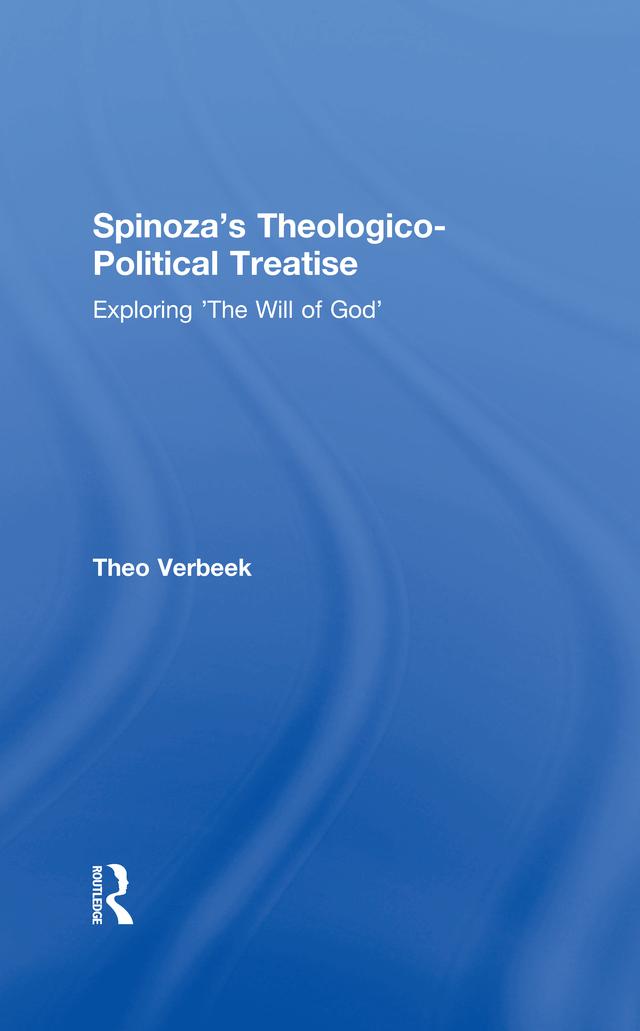
This book presents the first accessible analysis of Spinoza's Tractatus Theologico-politicus, situating the work in the context of Spinoza’s general philosophy and its 17th-century historical background. According to Spinoza it is impossible for a being to be infinitely perfect and to have a legislative will. This idea, demonstrated in the Ethics, is presupposed and further elaborated in the Tractatus Theologico-politicus. It implies not only that on the level of truth all revealed religion is false, but also that all authority is of human origin and that all obedience is rooted in a political structure. The consequences for authority as it is used in a religious context are explored: the authority of Scripture, the authority of particular interpretations of Scripture, and the authority of the Church. Verbeek also explores the work of two other philosophers of the period - Hobbes and Descartes - to highlight certain peculiarities of Spinoza's position, and to show the contrasts between their theories.
Betala smidigt med kort, Klarna, Apple Pay eller Google Pay. Är du inte nöjd har du alltid 14 dagars ångerrätt. Läs mer i våra villkor. Har du några frågor, mejla oss på hello@memmo.org.
Memmo gör det enklare att plugga – var du än är i världen. Hos oss samlar du kursböcker och smarta studieverktyg på ett och samma ställe: sammanfattningar, quiz, poddar och flashcards. Och så Ted, din studiekompis som svarar på allt du undrar. Över 50 000 studenter pluggar redan här – byggt för att du ska lära dig snabbare och stressa mindre.
Du kanske också gillar
Köp boken0