
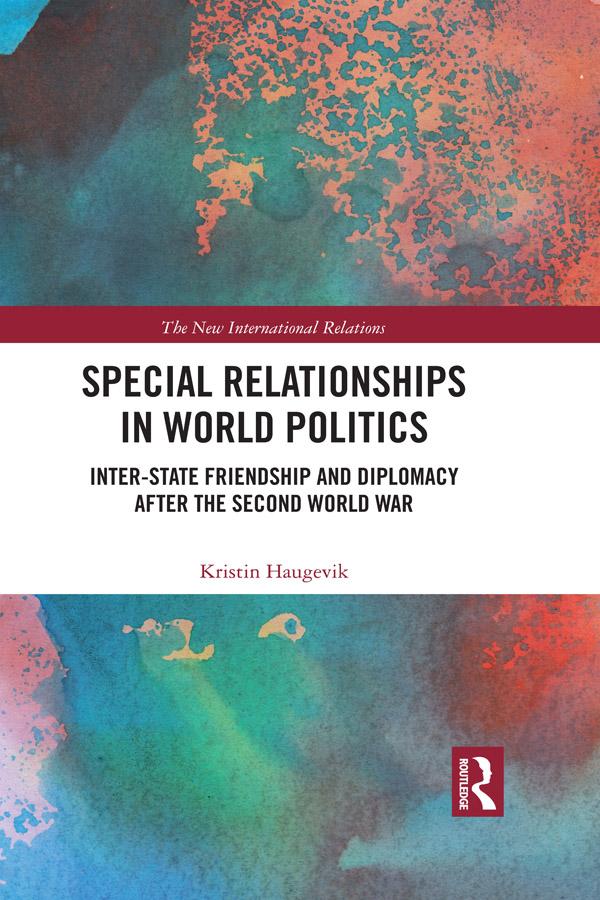
Claims of inter-state ‘specialness’ are commonplace in international politics. But how do some relationships between states come to be seen and categorized as ‘special’ in the first place? And what impact, if any, do recurring public representations of specialness have on states’ political and diplomatic interaction?
While much scholarly work exists on alleged instances of special relationships, and on inter-state cooperation and alliances more generally, little systematic and theory informed research has been conducted on how special relationships evolve and unfold in practice. This book offers such a comprehensive study. Theorizing inter-state relations as ongoing social processes, it makes the case for approaching special relationships as constituted and upheld through linguistic representations and bilateral interaction practices. Haugevik explores this claim through an in-depth study of how the bilateral relationship most frequently referred to as ‘special’ – the US-British – has unfolded over the last seventy years. This analysis is complemented with a study of Britain’s relationship with a more junior partner, Norway, during the same period.
The book offers an original take on inter-state relations and diplomacy during the Cold War and after, and develops an analytical framework for understanding why some state relationships maintain their status as ‘special’, while others end up as ‘benignly neglected’ ones.
Betala smidigt med kort, Klarna, Apple Pay eller Google Pay. Är du inte nöjd har du alltid 14 dagars ångerrätt. Läs mer i våra villkor. Har du några frågor, mejla oss på hello@memmo.org.
Memmo gör det enklare att plugga – var du än är i världen. Hos oss samlar du kursböcker och smarta studieverktyg på ett och samma ställe: sammanfattningar, quiz, poddar och flashcards. Och så Ted, din studiekompis som svarar på allt du undrar. Över 50 000 studenter pluggar redan här – byggt för att du ska lära dig snabbare och stressa mindre.