
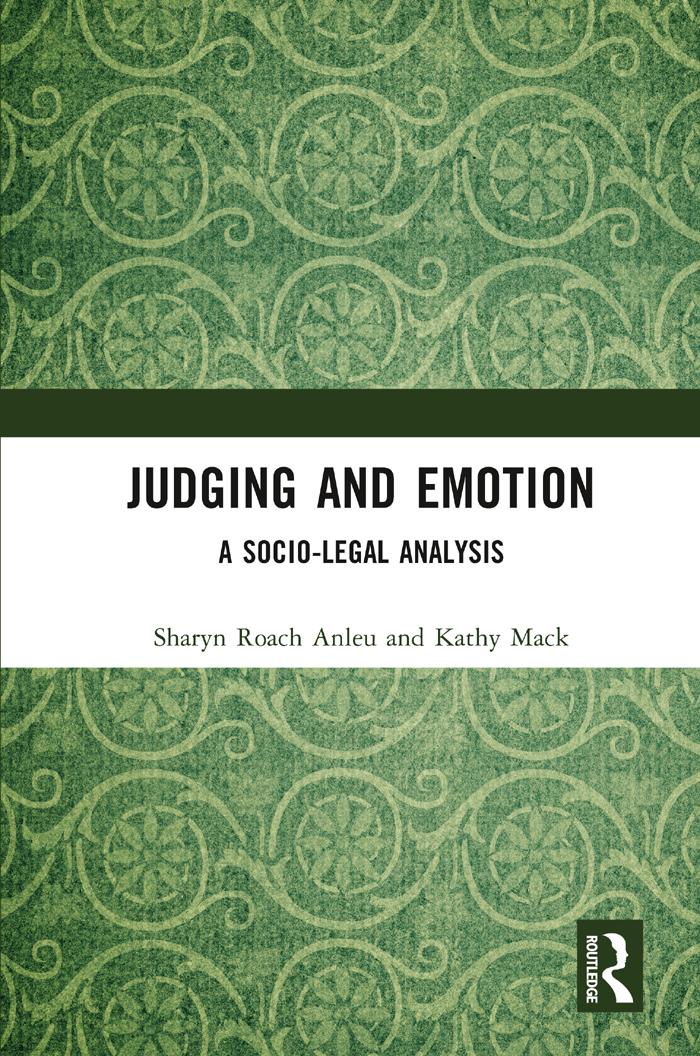
Judging and Emotion investigates how judicial officers understand, experience, display, manage and deploy emotions in their everyday work, in light of their fundamental commitment to impartiality.
Judging and Emotion challenges the conventional assumption that emotion is inherently unpredictable, stressful or a personal quality inconsistent with impartiality. Extensive empirical research with Australian judicial officers demonstrates the ways emotion, emotional capacities and emotion work are integral to judicial practice. Judging and Emotion articulates a broader conception of emotion, as a social practice emerging from interaction, and demonstrates how judicial officers undertake emotion work and use emotion as a resource to achieve impartiality. A key insight is that institutional requirements, including conceptions of impartiality as dispassion, do not completely determine the emotion dimensions of judicial work. Through their everyday work, judicial officers construct and maintain the boundaries of an impartial judicial role which necessarily incorporates emotion and emotion work.
Building on a growing interest in emotion in law and social sciences, this book will be of considerable importance to socio-legal scholars, sociologists, the judiciary, legal practitioners and all users of the courts.
Betala smidigt med kort, Klarna, Apple Pay eller Google Pay. Är du inte nöjd har du alltid 14 dagars ångerrätt. Läs mer i våra villkor. Har du några frågor, mejla oss på hello@memmo.org.
Memmo gör det enklare att plugga – var du än är i världen. Hos oss samlar du kursböcker och smarta studieverktyg på ett och samma ställe: sammanfattningar, quiz, poddar och flashcards. Och så Ted, din studiekompis som svarar på allt du undrar. Över 50 000 studenter pluggar redan här – byggt för att du ska lära dig snabbare och stressa mindre.