
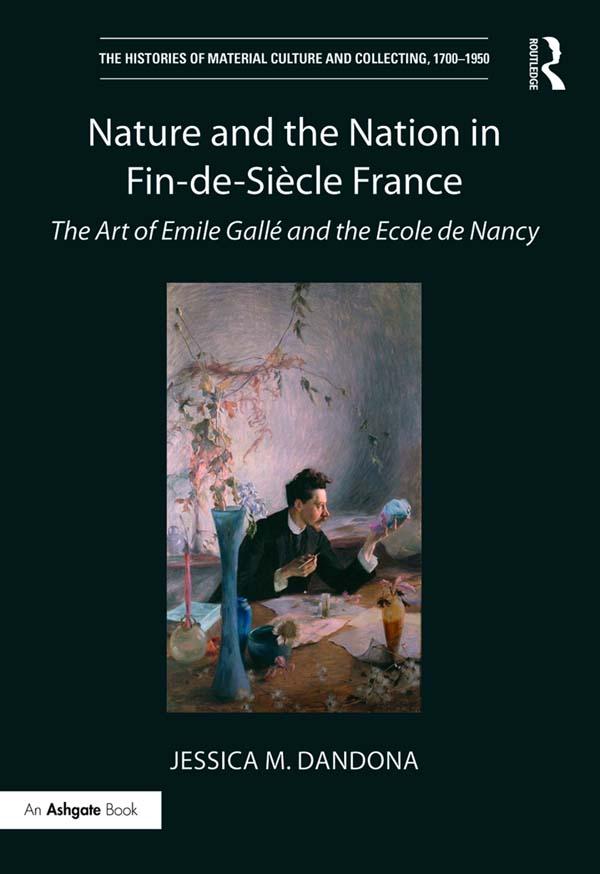
By the time of his death in 1904, critics, arts reformers, and government officials were near universal in their praise of Art Nouveau designer Emile Gallé (1846–1904), whose works they described as the essence of French design. Many even went so far as to argue that the artist’s creations could reinvigorate France’s fading arts industries and help restore its economic prosperity by defining a modern style to represent the nation. For fin-de-siècle viewers, Gallé’s works constituted powerful reflections on the idea of national belonging, modernity, and the role of the arts in political engagement. While existing scholarship has largely focused on the artist’s innovative technical processes, a close analysis of Gallé’s works brings to light the surprisingly complex ways in which his fragile creations were imbricated in the political turmoil that characterized fin-de-siècle France. Examining Gallé’s works inspired by Japanese art, his patriotically inflected designs for the Universal Exposition of 1889, his artistic manifesto in support of Dreyfus created in 1900, and finally, his late works that explore the concept of evolution, this book reveals how Gallé returns again and again to the question of national identity as the central issue in his work.
Betala smidigt med kort, Klarna, Apple Pay eller Google Pay. Är du inte nöjd har du alltid 14 dagars ångerrätt. Läs mer i våra villkor. Har du några frågor, mejla oss på hello@memmo.org.
Memmo gör det enklare att plugga – var du än är i världen. Hos oss samlar du kursböcker och smarta studieverktyg på ett och samma ställe: sammanfattningar, quiz, poddar och flashcards. Och så Ted, din studiekompis som svarar på allt du undrar. Över 75 000 studenter pluggar redan här – byggt för att du ska lära dig snabbare och stressa mindre.