
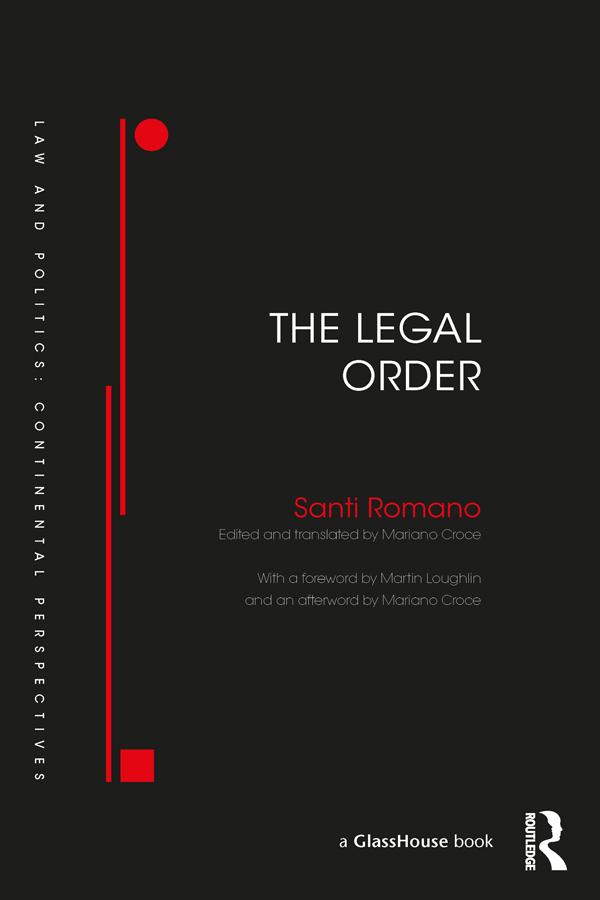
First published in 1917 (Part 1) and 1918 (Part 2), with a second edition in 1946, this is the first English translation of Santi Romano’s classic work, L’ordinamento giuridico (The Legal Order). The main focus of The Legal Order is the notion of institution, which Romano considers to be both the core and distinguishing feature of law. After criticising accounts of the nature of law centred on notions of rule, coercion or authority, he offers a compelling conception, not merely of law as an institution, but of the institution as ‘the first, original and essential manifestation of law’. Romano advances a definition of a legal institution as any group who share rules within a bounded context: for example, a family, a firm, a factory, a prison, an association, a church, an illegal organisation, a state, the community of states, and so on. Therefore, this understanding of legal institutionalism at the same time provides a ground-breaking theory of legal pluralism whereby ‘there are as many legal orders as institutions’. The acme of a jurisprudential current long overlooked in the Anglophone environment (Romano’s work is highly regarded in France, Germany, Spain and South America, as well as in Italy), The Legal Order not only proposes what Carl Schmitt described as a ‘very significant theory’. More importantly, it offers precious insights for a thorough rethinking of the relationship between law and society in today’s world.
Betala smidigt med kort, Klarna, Apple Pay eller Google Pay. Är du inte nöjd har du alltid 14 dagars ångerrätt. Läs mer i våra villkor. Har du några frågor, mejla oss på hello@memmo.org.
Memmo gör det enklare att plugga – var du än är i världen. Hos oss samlar du kursböcker och smarta studieverktyg på ett och samma ställe: sammanfattningar, quiz, poddar och flashcards. Och så Ted, din studiekompis som svarar på allt du undrar. Över 50 000 studenter pluggar redan här – byggt för att du ska lära dig snabbare och stressa mindre.