
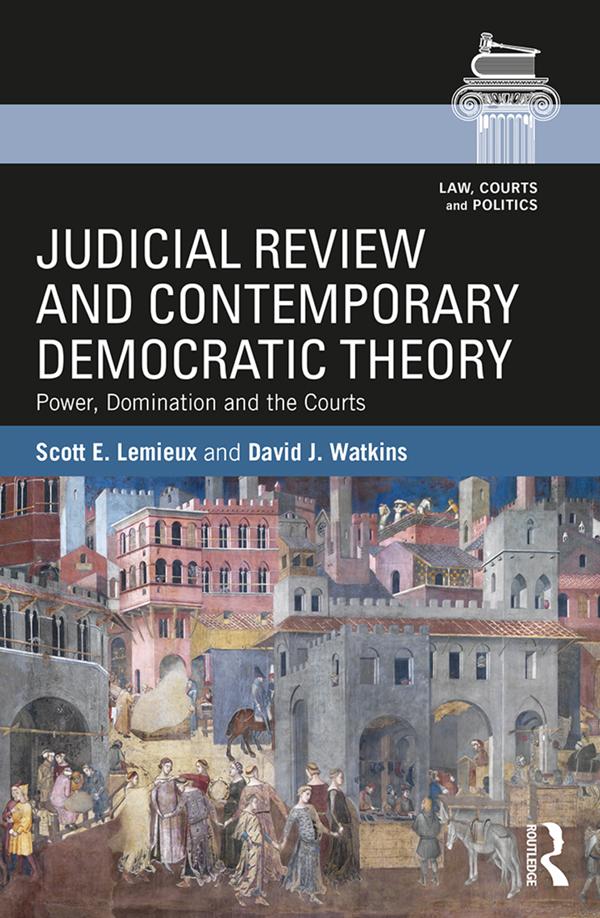
For decades, the question of judicial review’s status in a democratic political system has been adjudicated through the framework of what Alexander Bickel labeled "the counter-majoritarian difficulty." That is, the idea that judicial review is particularly problematic for democracy because it opposes the will of the majority.
Judicial Review and Contemporary Democratic Theory begins with an assessment of the empirical and theoretical flaws of this framework, and an account of the ways in which this framework has hindered meaningful investigation into judicial review’s value within a democratic political system. To replace the counter-majoritarian difficulty framework, Scott E. Lemieux and David J. Watkins draw on recent work in democratic theory emphasizing democracy’s opposition to domination and analyses of constitutional court cases in the United States, Canada, and elsewhere to examine judicial review in its institutional and political context.
Developing democratic criteria for veto points in a democratic system and comparing them to each other against these criteria, Lemieux and Watkins yield fresh insights into judicial review’s democratic value. This book is essential reading for students of law and courts, judicial politics, legal theory and constitutional law.
Betala smidigt med kort, Klarna, Apple Pay eller Google Pay. Är du inte nöjd har du alltid 14 dagars ångerrätt. Läs mer i våra villkor. Har du några frågor, mejla oss på hello@memmo.org.
Memmo gör det enklare att plugga – var du än är i världen. Hos oss samlar du kursböcker och smarta studieverktyg på ett och samma ställe: sammanfattningar, quiz, poddar och flashcards. Och så Ted, din studiekompis som svarar på allt du undrar. Över 50 000 studenter pluggar redan här – byggt för att du ska lära dig snabbare och stressa mindre.