
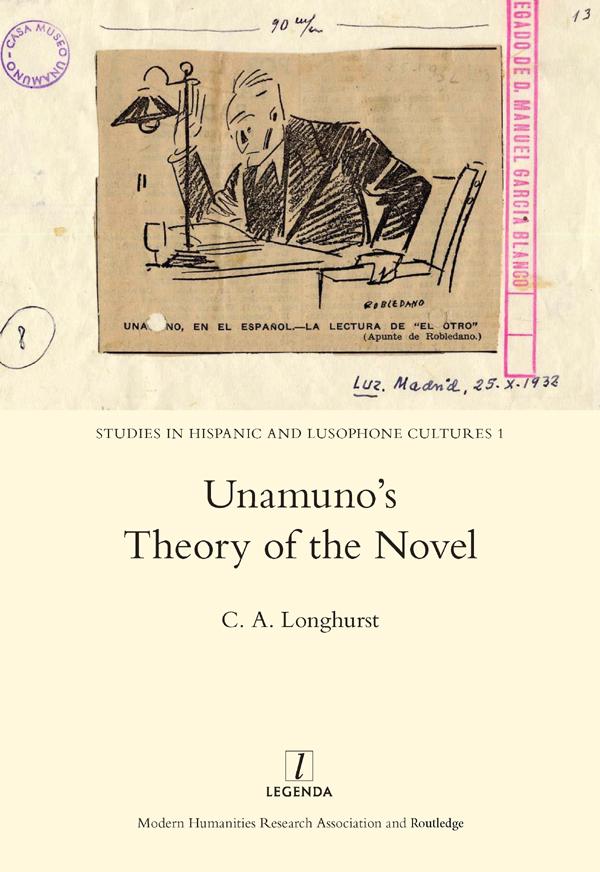
Miguel de Unamuno (1864-1936) is widely regarded as Spain's greatest and most controversial writer of the first half of the twentieth century. Professor of Greek, and later Rector, at the University of Salamanca, and a figure with a noted public profile in his day, he wrote a large number of philosophical, political and philological essays, as well as poems, plays and short stories, but it is his highly idiosyncratic novels, for which he coined the word nivola, that have attracted the greatest critical attention. Niebla (Mist, 1914) has become one of the most studied works of Spanish literature, such is the enduring fascination which it has provoked. In this study, C. A. Longhurst, a distinguished Unamuno scholar, sets out to show that behind Unamuno's fictional experiments there lies a coherent and quasi-philosophical concept of the novelesque genre and indeed of writing itself. Ideas about freedom, identity, finality, mutuality and community are closely intertwined with ideas on writing and reading and give rise to a new and highly personal way of conceiving fiction.
Sidor: 227
Kategori: Litteraturvetenskap & Teori
e-ISBN: 9781351538206
Fraktvikt: 1.2 kg
Skickas inom: 1-2 dagar
Betala smidigt med kort, Klarna, Apple Pay eller Google Pay. Är du inte nöjd har du alltid 14 dagars ångerrätt. Läs mer i våra villkor. Har du några frågor, mejla oss på hello@memmo.org.
Memmo gör det enklare att plugga – var du än är i världen. Hos oss samlar du kursböcker och smarta studieverktyg på ett och samma ställe: sammanfattningar, quiz, poddar och flashcards. Och så Ted, din studiekompis som svarar på allt du undrar. Över 50 000 studenter pluggar redan här – byggt för att du ska lära dig snabbare och stressa mindre.
Du kanske också gillar
Köp boken0