
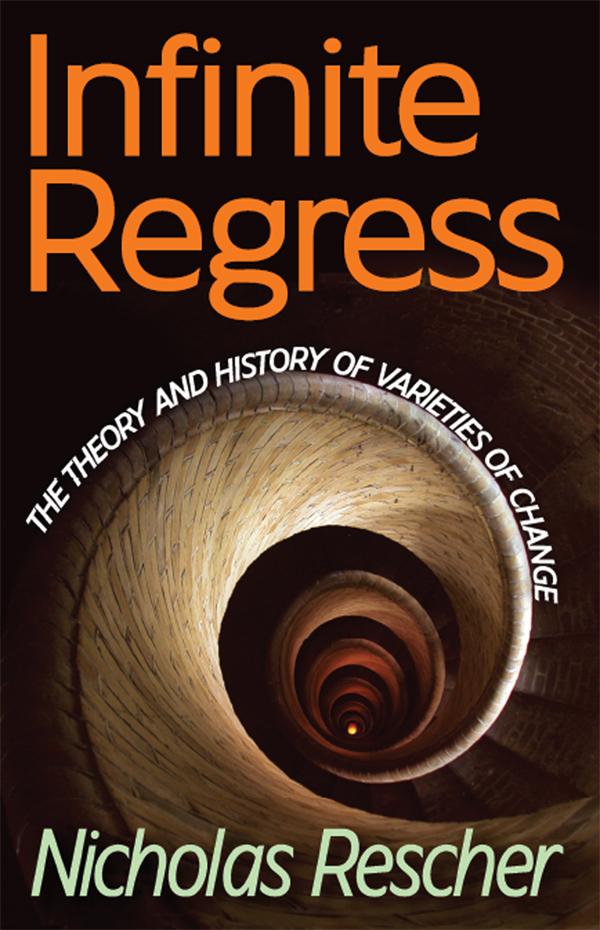
Regression addresses what has come before; it is a matter of looking backward of retrospections? The motionless things of nature are generally forward-looking their problem is that of the question: Where do we go from here? It is primarily with intelligent beings that we ask: How did we get to where we now find ourselves? Regression and infinite regression in particular is thus a concept that has gained a greater prominence in the human sciences than in the sciences of nature. Argumentation to infinite regress has long been a favored instrument of philosophical dialectic. Philosophers have used it to disprove the positions they model to criticize. Infinite regresses, so they reason, are unrealizable: they cannot be completed so as to achieve some definitive result. And thereby anything that would engender an infinite regress is automatically made ineffective. Infinite Regress examines the theory of regression and includes information on the topics of vicious regress, innocuous regress, circularity regress, and propositional regress. Also discussed is the history of regression stemming from ancient times, to medieval times, to early modern history. Some of the other chapters in this book focus on world class philosophers including Immanuel Kant, Georg Wilhelm Friedrich Hegel, and Bertrand Russell. The book will play a significant role in theoretical philosophy as well as in social philosophy and the philosophy of mind.
Betala smidigt med kort, Klarna, Apple Pay eller Google Pay. Är du inte nöjd har du alltid 14 dagars ångerrätt. Läs mer i våra villkor. Har du några frågor, mejla oss på hello@memmo.org.
Memmo gör det enklare att plugga – var du än är i världen. Hos oss samlar du kursböcker och smarta studieverktyg på ett och samma ställe: sammanfattningar, quiz, poddar och flashcards. Och så Ted, din studiekompis som svarar på allt du undrar. Över 50 000 studenter pluggar redan här – byggt för att du ska lära dig snabbare och stressa mindre.
Du kanske också gillar
Köp boken0