
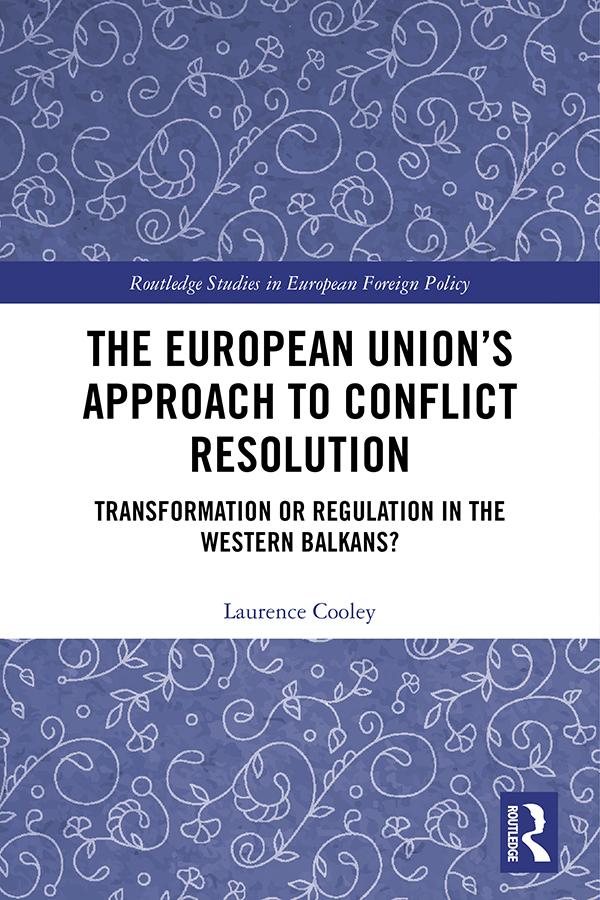
This book investigates and explains the European Union’s approach to conflict resolution in three countries of the Western Balkans: Bosnia and Herzegovina, Macedonia and Kosovo. In doing so, it critically interrogates claims that the EU acts as an agent of conflict transformation in its engagement with conflict-affected states. The book argues, contrary to the assumptions of much of the existing literature, that rather than seeking the transformation of conflicts, the EU pursues a more conservative strategy based on the regulation of conflict through the promotion of institutional mechanisms such as consociational power sharing and decentralisation.
Drawing on discourse analysis of documents, speeches, and interviews conducted by the author with European Union officials and policy-makers in Brussels and the case-study countries, the book offers a theoretically grounded, methodologically rigorous and empirically detailed analysis of EU policy preferences, of the ideas that underpin them, and of how those preferences are legitimised.
This book will be of key interest to scholars, students and practitioners interested in ethnic conflict and conflict resolution, the politics of the Balkans, and the external and foreign policies of the EU.
Betala smidigt med kort, Klarna, Apple Pay eller Google Pay. Är du inte nöjd har du alltid 14 dagars ångerrätt. Läs mer i våra villkor. Har du några frågor, mejla oss på hello@memmo.org.
Memmo gör det enklare att plugga – var du än är i världen. Hos oss samlar du kursböcker och smarta studieverktyg på ett och samma ställe: sammanfattningar, quiz, poddar och flashcards. Och så Ted, din studiekompis som svarar på allt du undrar. Över 50 000 studenter pluggar redan här – byggt för att du ska lära dig snabbare och stressa mindre.