
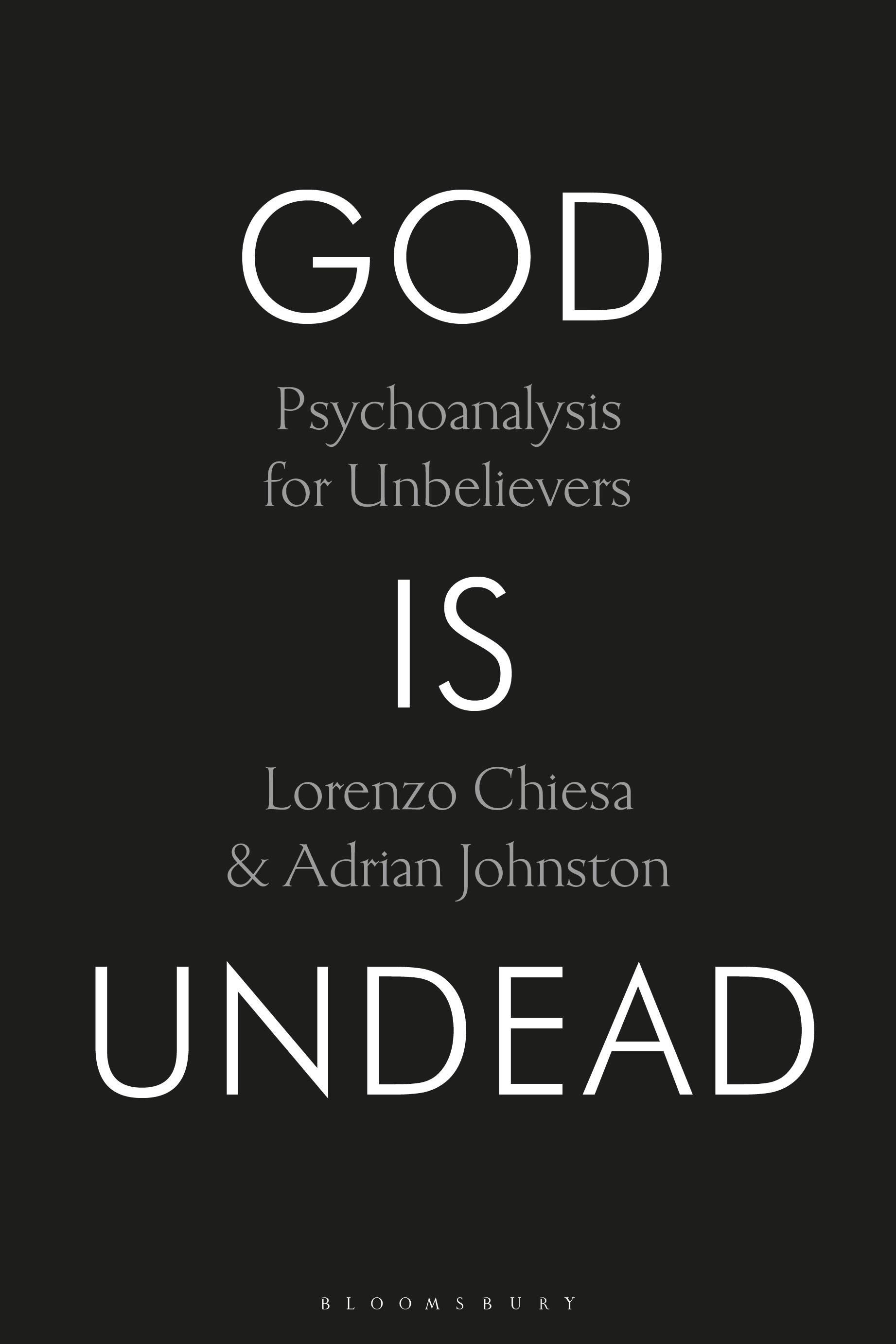
The undead are neither alive nor dead. They are animate yet non-living. In God Is Undead, Lorenzo Chiesa and Adrian Johnston contend that true unbelief today sees the divine precisely as exemplifying such undeath.
In God Is Undead, Chiesa and Johnston delve into and deepen the insights of both Freudian and Lacanian psychoanalysis as regards unbelief. This analytic perspective reveals that modern atheisms appealing to a scientific worldview as an antidote to orthodox religious faith end up as heterodox theisms of Nature, Reason, Knowledge, or even the Market itself. They ironically place new gods of their own atop the graves of the traditional gods of old. They likewise forget the religious influences underlying modern science.
One of the most important and novel contributions of God Is Undead is its gesture of dignifying unbelief as something that is able to contain multitudes. Far from a unified, homogeneous, and flatly bleak position, irreligiosity can come in many forms whose convergences and divergences contain possibilities for creatively thinking and living differently. This book shows such variegated non-belief in action. We have two unbelievers vigorously disagreeing with each other about fundamental ontological matters, thereby bringing to light critical questions going to the very heart of any unbelief whatsoever: Can an atheism, as thoroughly atheistic, ever believe in or be certain of itself? What is the role of agnosticism, and specifically of an agnosticism strengthening (rather than contrasting with) atheism, in all this? How might different unbelievers become what Freud calls “comrades in unbelief” without erecting new gods in the process?
In God Is Undead, Chiesa and Johnston delve into and deepen the insights of both Freudian and Lacanian psychoanalysis as regards unbelief. This analytic perspective reveals that modern atheisms appealing to a scientific worldview as an antidote to orthodox religious faith end up as heterodox theisms of Nature, Reason, Knowledge, or even the Market itself. They ironically place new gods of their own atop the graves of the traditional gods of old. They likewise forget the religious influences underlying modern science.
One of the most important and novel contributions of God Is Undead is its gesture of dignifying unbelief as something that is able to contain multitudes. Far from a unified, homogeneous, and flatly bleak position, irreligiosity can come in many forms whose convergences and divergences contain possibilities for creatively thinking and living differently. This book shows such variegated non-belief in action. We have two unbelievers vigorously disagreeing with each other about fundamental ontological matters, thereby bringing to light critical questions going to the very heart of any unbelief whatsoever: Can an atheism, as thoroughly atheistic, ever believe in or be certain of itself? What is the role of agnosticism, and specifically of an agnosticism strengthening (rather than contrasting with) atheism, in all this? How might different unbelievers become what Freud calls “comrades in unbelief” without erecting new gods in the process?
Betala smidigt med kort, Klarna, Apple Pay eller Google Pay. Är du inte nöjd har du alltid 14 dagars ångerrätt. Läs mer i våra villkor. Har du några frågor, mejla oss på hello@memmo.org.
Memmo gör det enklare att plugga – var du än är i världen. Hos oss samlar du kursböcker och smarta studieverktyg på ett och samma ställe: sammanfattningar, quiz, poddar och flashcards. Och så Ted, din studiekompis som svarar på allt du undrar. Över 50 000 studenter pluggar redan här – byggt för att du ska lära dig snabbare och stressa mindre.