
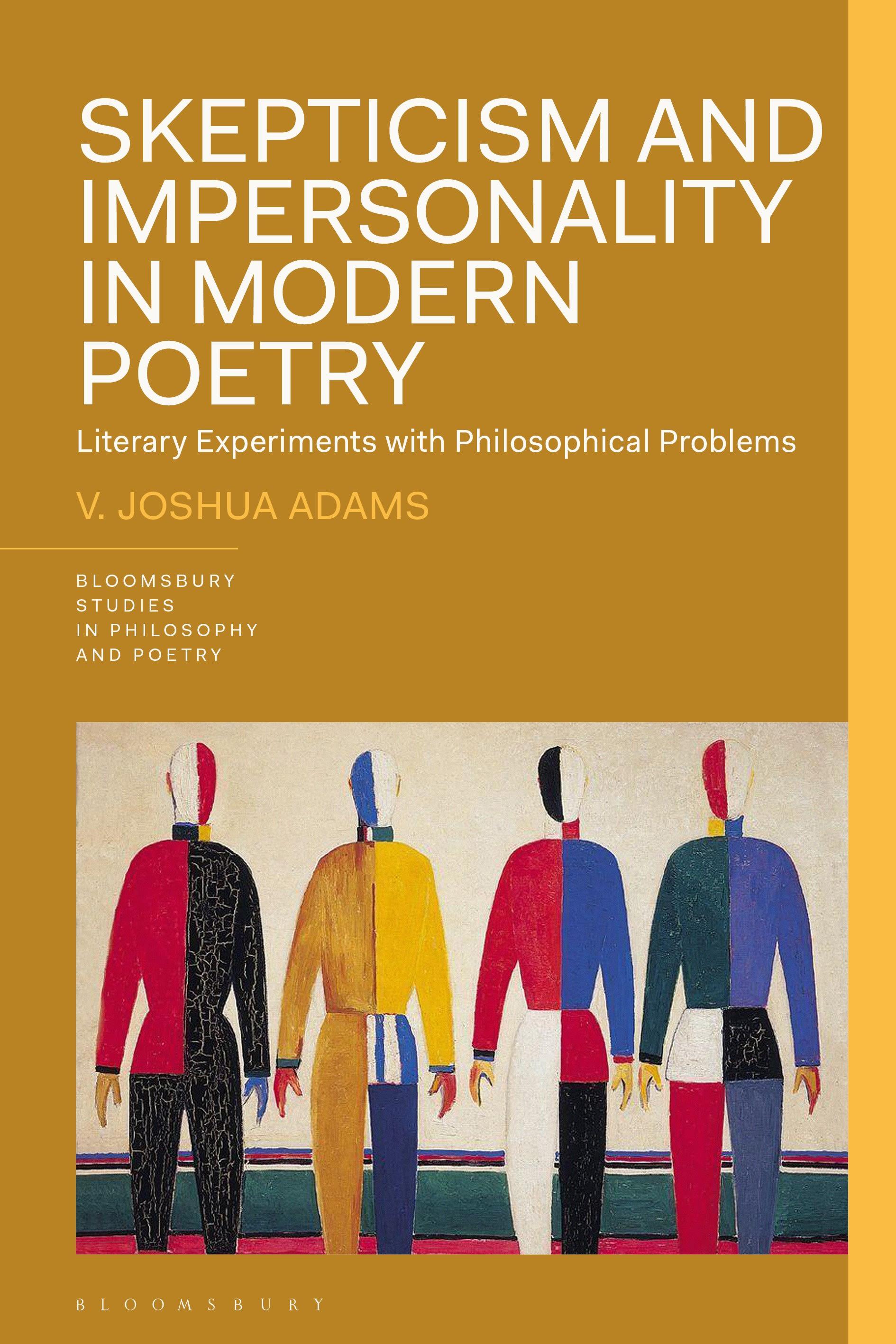
Modern literature is often described in terms of its impersonality. What is the significance of this fact?
In Skepticism and Impersonality, V. Joshua Adams follows the history of impersonality in modern poetry from Mallarmé and Eliot through to the present, engaging with work by major poets and critics, but also contemporary philosophers. Rather than seeing impersonality exclusively as a literary historical phenomenon, Adams argues that we should understand it as an attempt to address skeptical problems arising from the limitations of first-person experience.
Defending impersonality as a response to skeptical problems, including doubts about the publicity of our experiences, our knowledge of other minds, the capacity of our language to describe the world, the relationship between mind and body, and the fictionality and continuity of our sense of self, Adams analyzes what he calls “experiments in impersonality” as means of working through skeptical doubt. The writers discussed transform this doubt into art, whilst also ironizing it as corrosive and self-defeating. Ultimately this leads Adams to reinterpret literary impersonality as a therapeutic philosophical project.
Skepticism and Impersonality promises a new theoretical justification for our practical interest in literary texts, to renovate our conception of how those texts might do philosophical work, and to expand our sense of what a philosophical poem can be.
In Skepticism and Impersonality, V. Joshua Adams follows the history of impersonality in modern poetry from Mallarmé and Eliot through to the present, engaging with work by major poets and critics, but also contemporary philosophers. Rather than seeing impersonality exclusively as a literary historical phenomenon, Adams argues that we should understand it as an attempt to address skeptical problems arising from the limitations of first-person experience.
Defending impersonality as a response to skeptical problems, including doubts about the publicity of our experiences, our knowledge of other minds, the capacity of our language to describe the world, the relationship between mind and body, and the fictionality and continuity of our sense of self, Adams analyzes what he calls “experiments in impersonality” as means of working through skeptical doubt. The writers discussed transform this doubt into art, whilst also ironizing it as corrosive and self-defeating. Ultimately this leads Adams to reinterpret literary impersonality as a therapeutic philosophical project.
Skepticism and Impersonality promises a new theoretical justification for our practical interest in literary texts, to renovate our conception of how those texts might do philosophical work, and to expand our sense of what a philosophical poem can be.
Sidor: 248
Kategori: Litteraturvetenskap & Teori
e-ISBN: 9781350259669
Fraktvikt: 1.2 kg
Skickas inom: 1-2 dagar
Betala smidigt med kort, Klarna, Apple Pay eller Google Pay. Är du inte nöjd har du alltid 14 dagars ångerrätt. Läs mer i våra villkor. Har du några frågor, mejla oss på hello@memmo.org.
Memmo gör det enklare att plugga – var du än är i världen. Hos oss samlar du kursböcker och smarta studieverktyg på ett och samma ställe: sammanfattningar, quiz, poddar och flashcards. Och så Ted, din studiekompis som svarar på allt du undrar. Över 50 000 studenter pluggar redan här – byggt för att du ska lära dig snabbare och stressa mindre.