
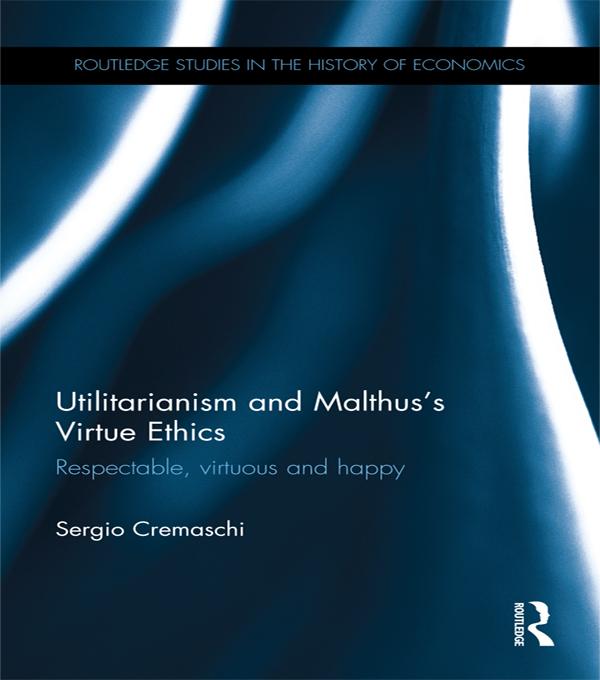
The die-hard image of Malthus the ogre has not completely disappeared yet. And yet, Malthus showed no less concern than Adam Smith for the labouring poor. In order to make full sense of such expression of concern and to appraise their relevance in Malthus’s work, we need to know what moral philosophy, what view of natural science, and what view of the "moral and political science" Malthus endorsed.
This book reconstructs Malthus’s meta-ethics, his normative ethics and his applied ethics on such topics as population, poverty, sexuality and war and slavery. They show how Malthus’s understanding of his own population theory and political economy was that of sub-disciplines of moral and political philosophy. Empirical enquiries required in order to be able to pronounce justified value judgments on such matters as the Poor Laws. But Malthus’s population theory and political economy were no value-free science and his non-utilitarian policy advice resulted from his overall system of ideas and was explicitly based on a set of familiar moral assumptions.
It is mistaken to claim that Malthus’s explanation of disharmony by reference to Divine Wisdom is extraneous to analysis and without influence on the theory of policy; it is true instead that theological consequentialist considerations were appealed to in order to provide a justification for received moral rules, but these were meant to justify a rather traditional normative ethics, quite far from Benthamite ‘new morality’.
Betala smidigt med kort, Klarna, Apple Pay eller Google Pay. Är du inte nöjd har du alltid 14 dagars ångerrätt. Läs mer i våra villkor. Har du några frågor, mejla oss på hello@memmo.org.
Memmo gör det enklare att plugga – var du än är i världen. Hos oss samlar du kursböcker och smarta studieverktyg på ett och samma ställe: sammanfattningar, quiz, poddar och flashcards. Och så Ted, din studiekompis som svarar på allt du undrar. Över 50 000 studenter pluggar redan här – byggt för att du ska lära dig snabbare och stressa mindre.