
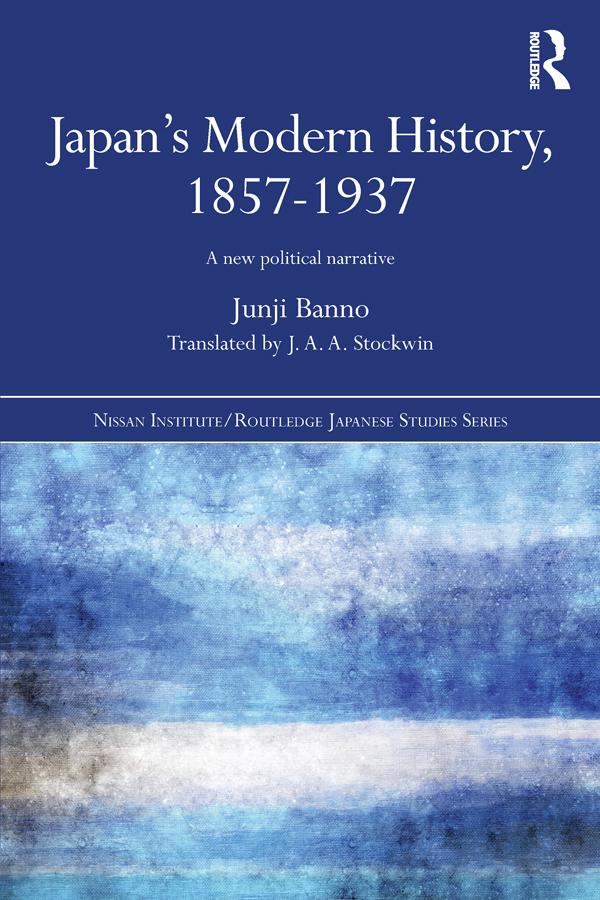
Over the course of the period 1857 to 1937 in Japan, six distinct stages can be identified as the country moved from Shogun rule and its subsequent overthrow, from industrialisation and investment to the Meiji Constitution and then from Taishō democracy to Shōwa fascism. In this book, Junji Banno stresses the mutual relationships between each period, and to this end renames then accordingly: the age of reform; age of revolution; age of construction; age of management; age of reorganisation; and age of crisis.
Following this model, the book covers eighty years of history in Japan, focusing on political history and foreign relations, with extensive material also on economic development and foreign influences on political institutions and practices. Based on extensive archival research, Japan’s Modern History considers synoptically the key trends and their significance over the period of 1857 to 1937. In turn, it presents in detail fascinating information on many of the main leaders and other significant figures, with extensive quotations from their writings, letters and diaries.
This book is a translation into English of a major work of scholarship by a leading historian of modern Japan, and may be considered the apex of Junji Banno’s work in the field. As such, it will be of great interest to students and scholars of both Japanese history and history more broadly.
Betala smidigt med kort, Klarna, Apple Pay eller Google Pay. Är du inte nöjd har du alltid 14 dagars ångerrätt. Läs mer i våra villkor. Har du några frågor, mejla oss på hello@memmo.org.
Memmo gör det enklare att plugga – var du än är i världen. Hos oss samlar du kursböcker och smarta studieverktyg på ett och samma ställe: sammanfattningar, quiz, poddar och flashcards. Och så Ted, din studiekompis som svarar på allt du undrar. Över 50 000 studenter pluggar redan här – byggt för att du ska lära dig snabbare och stressa mindre.