
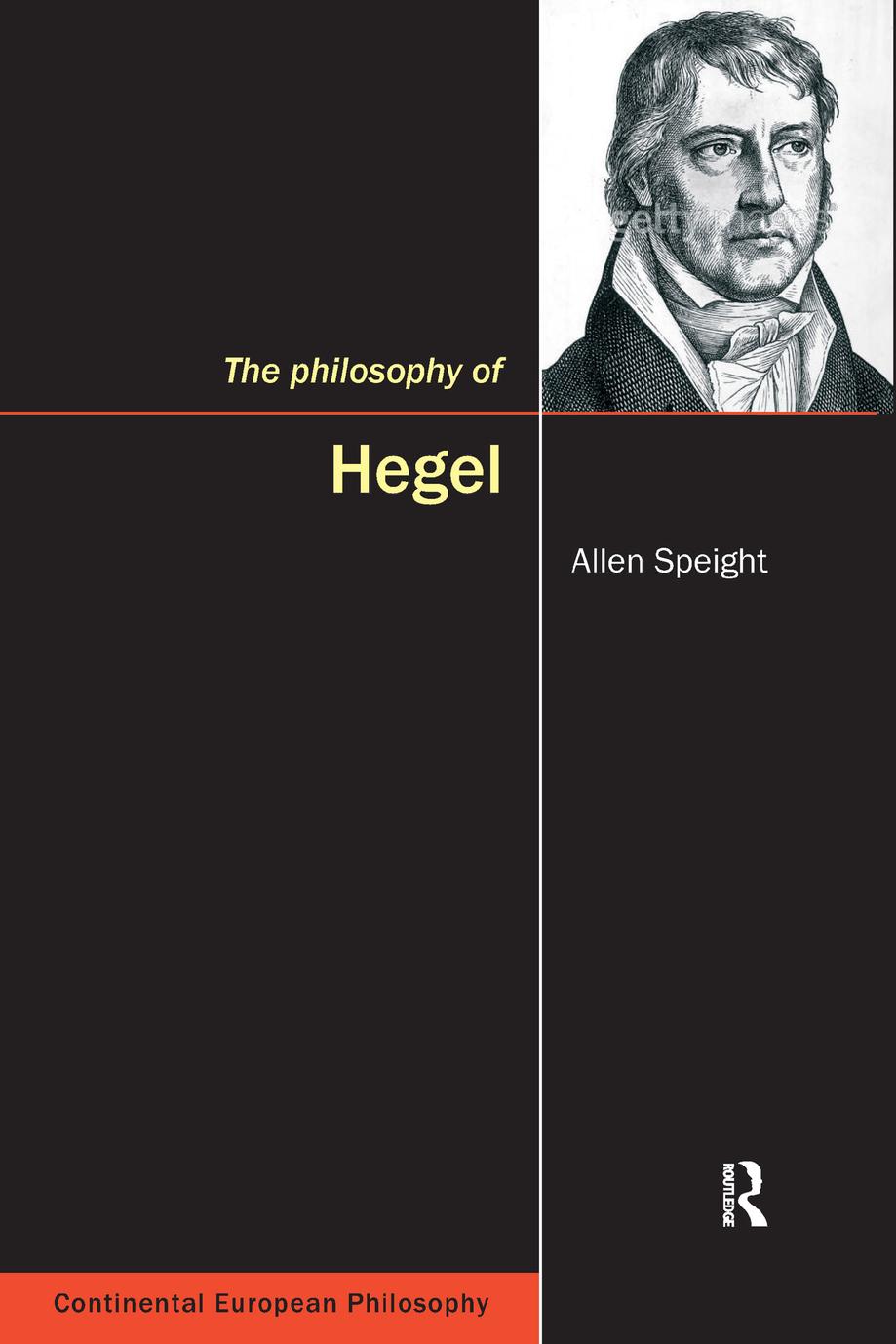
Few philosophers can induce as much puzzlement among students as Hegel. His works are notoriously dense and make very few concessions for a readership unfamiliar with his systematic view of the world. Allen Speight's introduction to Hegel's philosophy takes a chronological perspective on the development of Hegel's system. In this way, some of the most important questions in Hegelian scholarship are illuminated by examining in their respective contexts works such as the "Phenomenology and the Logic". Speight begins with the young Hegel and his writings prior to the "Phenomenology" focusing on the notion of positivity and how Hegel's social, economic and religious concerns became linked to systematic and logical ones. He then examines the "Phenomenology" in detail, including its treatment of scepticism, the problem of immediacy, the transition from "consciousness" to "self-consciousness", and the emergence of the social and historical category of "Spirit". The following chapter explores the Logic, paying particular attention to a number of vexed issues associated with Hegel's claims to systematicity and the relation between the categories of Hegel's logic and nature or spirit (Geist). The final chapters discuss Hegel's ethical and political thought and the three elements of his notion of "absolute spirit": art, religion and philosophy, as well as the importance of history to his philosophical approach as a whole.
Betala smidigt med kort, Klarna, Apple Pay eller Google Pay. Är du inte nöjd har du alltid 14 dagars ångerrätt. Läs mer i våra villkor. Har du några frågor, mejla oss på hello@memmo.org.
Memmo gör det enklare att plugga – var du än är i världen. Hos oss samlar du kursböcker och smarta studieverktyg på ett och samma ställe: sammanfattningar, quiz, poddar och flashcards. Och så Ted, din studiekompis som svarar på allt du undrar. Över 50 000 studenter pluggar redan här – byggt för att du ska lära dig snabbare och stressa mindre.
Du kanske också gillar
Köp boken0