
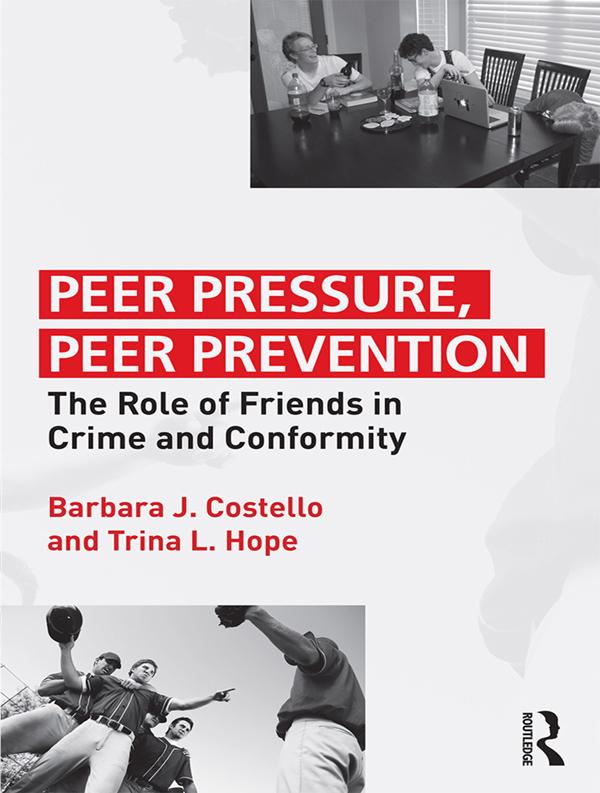
Criminological research has largely neglected the possibility that positive peer influence is a potentially powerful source of social control. Quantitative methods tease out cause, effect, and spuriousness in the relationship between peer delinquency and personal delinquency, but these methods do little or nothing to reveal how and why peers might influence each other toward--or away from--deviance.
Costello and Hope take a first step toward uncovering the mechanisms of peer influence, drawing on quantitative and qualitative data collected from two convenience samples of university students. Their quantitative analyses showed that positive peer influence occurs most frequently among those who associate with the most deviant peers and self-report the most deviance, contrary to predictions drawn from social learning theories. Their qualitative data revealed a variety of methods of negative influence, including encouraging deviant behavior for others' amusement, a motive for peer influence never before reported in the literature.
Betala smidigt med kort, Klarna, Apple Pay eller Google Pay. Är du inte nöjd har du alltid 14 dagars ångerrätt. Läs mer i våra villkor. Har du några frågor, mejla oss på hello@memmo.org.
Memmo gör det enklare att plugga – var du än är i världen. Hos oss samlar du kursböcker och smarta studieverktyg på ett och samma ställe: sammanfattningar, quiz, poddar och flashcards. Och så Ted, din studiekompis som svarar på allt du undrar. Över 50 000 studenter pluggar redan här – byggt för att du ska lära dig snabbare och stressa mindre.