
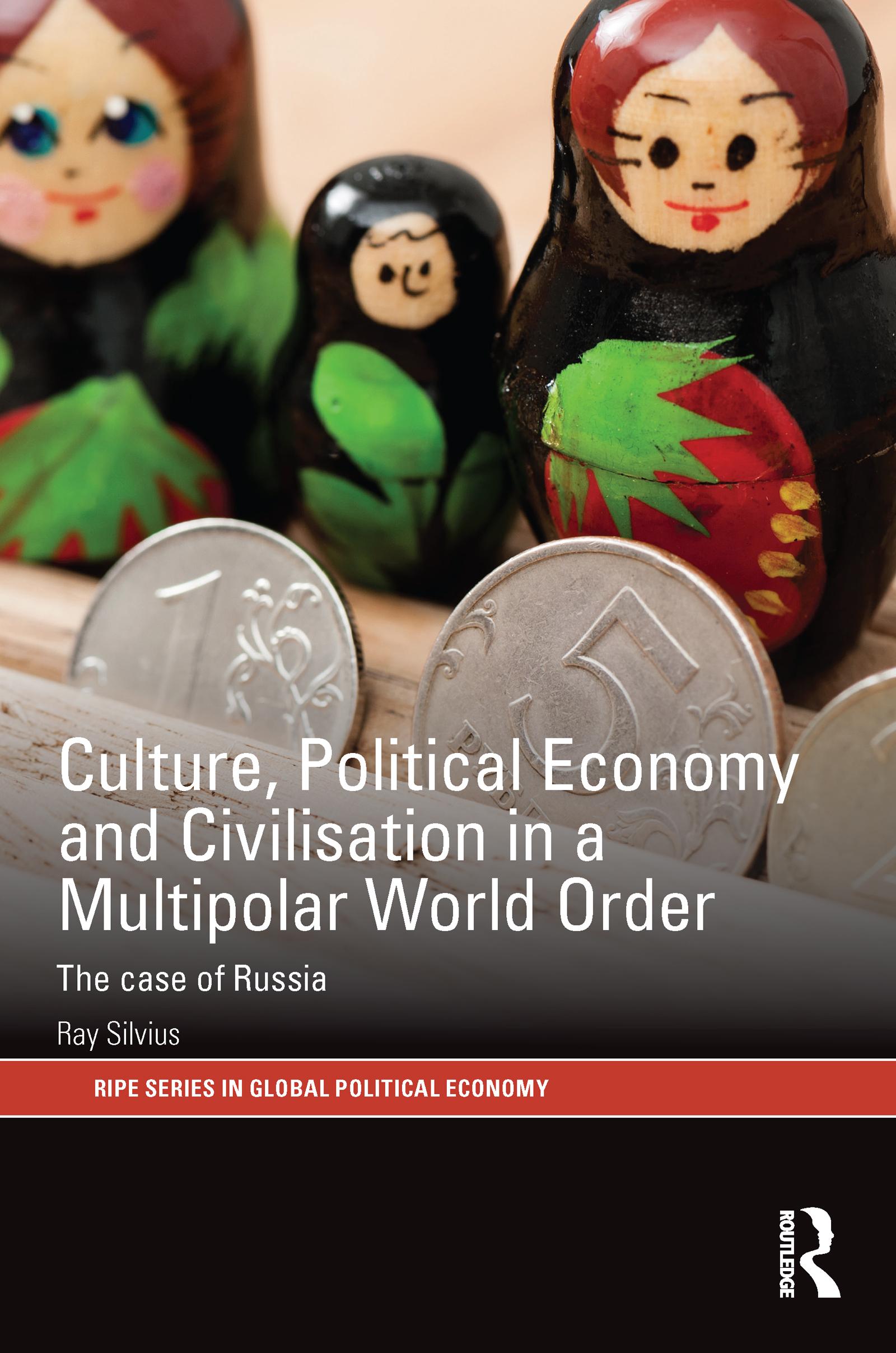
This book seeks to understand how Russia’s multifaceted rejection of American unipolarity and de-territorialised neo-liberal capitalism has contributed to the gestation of the present multipolar moment in the global political economy. Analysing Western world order precepts via the actions of a powerful, albeit precarious, national political economy and state structure situated on the periphery of Western world order, Silvius explores the manner in which culture and ideas are mobilised for the purposes of national, regional and international political and economic projects in a post-global age.
The book:
- Explains and analyses the tensions of post-Soviet Russia’s integration into, and simultaneous partial rejection of, the capitalist global political economy.
- Provides an overview of the social, political and historical origins of Russian samobytnost’ (uniqueness) after the fall of the Soviet Union and demonstrates their significance to contemporary understandings of world order.
- Explores how structures of cultural difference and practices of cultural differentiation interact with the normative legacies of American hegemonic aspirations in contemporary world order structures.
- Evaluates how cultural and civilisational representations are mobilised for state-projects and their corresponding regional and international dimensions within the global political economy.
This book will be of great interest to students and scholars of Russian Foreign Policy, IPE and comparative political economy.
Betala smidigt med kort, Klarna, Apple Pay eller Google Pay. Är du inte nöjd har du alltid 14 dagars ångerrätt. Läs mer i våra villkor. Har du några frågor, mejla oss på hello@memmo.org.
Memmo gör det enklare att plugga – var du än är i världen. Hos oss samlar du kursböcker och smarta studieverktyg på ett och samma ställe: sammanfattningar, quiz, poddar och flashcards. Och så Ted, din studiekompis som svarar på allt du undrar. Över 50 000 studenter pluggar redan här – byggt för att du ska lära dig snabbare och stressa mindre.