
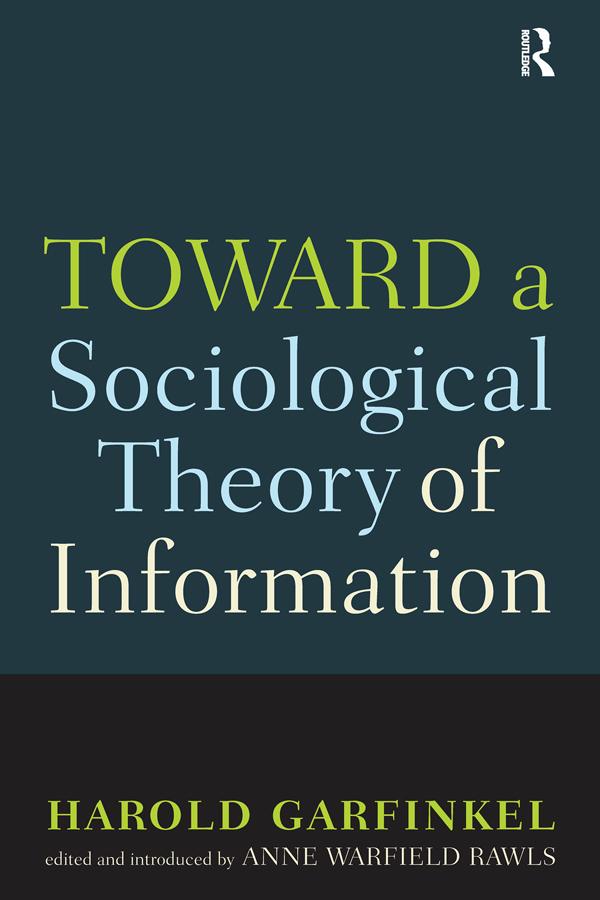
In 1952 at Princeton University, Harold Garfinkel developed a sociological theory of information. Other prominent theories then being worked out at Princeton, including game theory, neglected the social elements of "information," modeling a rational individual whose success depends on completeness of both reason and information. In real life these conditions are not possible and these approaches therefore have always had limited and problematic practical application. Garfinkel's sociological theory treats information as a thoroughly organized social phenomenon in a way that addresses these shortcomings comprehensively. Although famous as a sociologist of everyday life, Garfinkel focuses in this new book-never before published-on the concerns of large-scale organization and decisionmaking. In the fifty years since Garfinkel wrote this treatise, there has been no systematic treatment of the problems and issues he raises. Nor has anyone proposed a theory of information like the one he proposed. Many of the same problems that troubled theorists of information and predictable order in 1952 are still problematic today.
Betala smidigt med kort, Klarna, Apple Pay eller Google Pay. Är du inte nöjd har du alltid 14 dagars ångerrätt. Läs mer i våra villkor. Har du några frågor, mejla oss på hello@memmo.org.
Memmo gör det enklare att plugga – var du än är i världen. Hos oss samlar du kursböcker och smarta studieverktyg på ett och samma ställe: sammanfattningar, quiz, poddar och flashcards. Och så Ted, din studiekompis som svarar på allt du undrar. Över 50 000 studenter pluggar redan här – byggt för att du ska lära dig snabbare och stressa mindre.
Du kanske också gillar
Köp boken0