
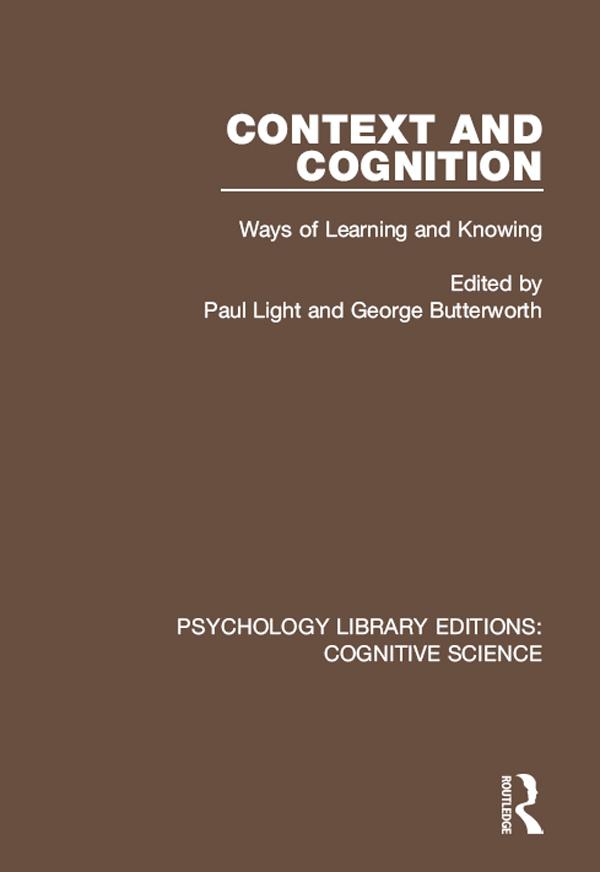
Originally published in 1993, the study of cognitive development in children had moved from a focus on the intellectual processes of the individual studied in relative isolation, as in the classic work of Piaget, to a concern in the 1970s and 1980s with social cognition characterized by Vygotsky's views. In the years following, the trend toward an understanding of the situated nature of cognition had evolved even further and the extent to which thinking and knowing are inextricably linked to contextual constraints was at last being defined.
Experts of international repute, the authors of this important book examine the recent literature on situated cognition in children. They explain contextual sensitivity in relation to ecological theories of cognition, and contrast intuitive reasoning in mathematical and other scientific domains with the failure of such reasoning in formal school contexts. Centrally concerned with the question of generalizability and transfer of knowledge from one situation to another, the contributors point to practical implications for understanding how intellectual competence can be made to generalize between "informal" and "formal" situations.
Betala smidigt med kort, Klarna, Apple Pay eller Google Pay. Är du inte nöjd har du alltid 14 dagars ångerrätt. Läs mer i våra villkor. Har du några frågor, mejla oss på hello@memmo.org.
Memmo gör det enklare att plugga – var du än är i världen. Hos oss samlar du kursböcker och smarta studieverktyg på ett och samma ställe: sammanfattningar, quiz, poddar och flashcards. Och så Ted, din studiekompis som svarar på allt du undrar. Över 50 000 studenter pluggar redan här – byggt för att du ska lära dig snabbare och stressa mindre.