
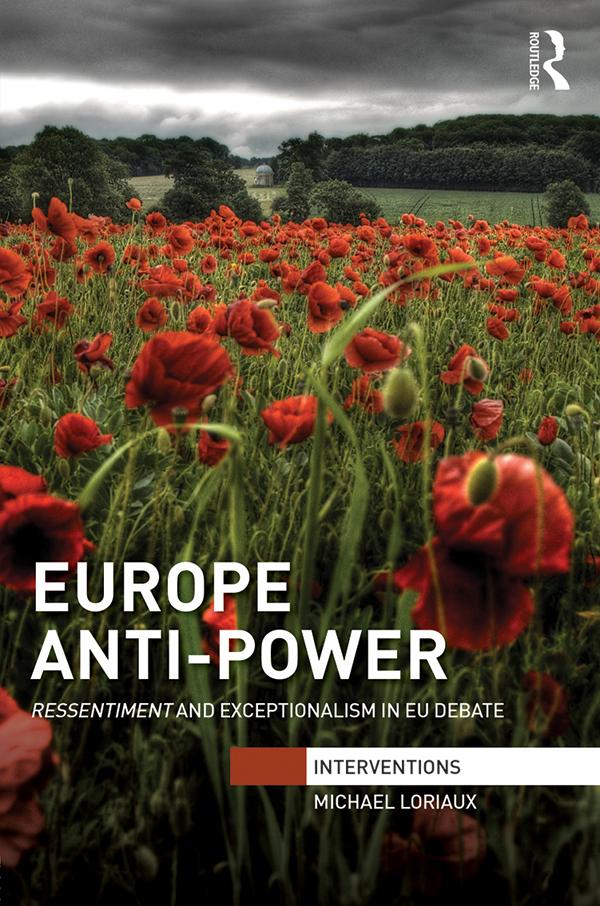
The EU seeks to define a role for itself in power politics while remaining firm in its rejection of power politics. In order to make power compatible with the European project, EU debate has appended a number of progressive adjectives to the word "power," adjectives like "civilian" and "normative," among others. This book asks what is power, such that it can be modified, tamed, and modulated by adjectives, yet remain "powerful"?
Loriaux passes EU debate on power through the mill of phenomenological and post-phenomenological analysis, juxtaposing it against writings by Machiavelli, Agamben, Thucydides, Nietzsche, Patocka, and Levinas. The book locates power in "power/play," the theatrical, staged representation of threat that generates aesthetic effect and undecidability. Power/play endows the word "power" with perlocutionary force, which the adjectives of EU "qualified" power actually enhance rather than moderate. Loriaux argues that EU discourse on power therefore risks inviting EU "exceptionalism," or risks lapsing into an expression of EU ressentiment, rather than advancing a new, progressive understanding of "power." If European Union is to remain steadfast in its opposition to power politics, it must represent itself as "anti-power."
This book will be of interest to those who work in the area of EU foreign policy, as well as to those who have a more general theoretical interest in the concept of power.
Betala smidigt med kort, Klarna, Apple Pay eller Google Pay. Är du inte nöjd har du alltid 14 dagars ångerrätt. Läs mer i våra villkor. Har du några frågor, mejla oss på hello@memmo.org.
Memmo gör det enklare att plugga – var du än är i världen. Hos oss samlar du kursböcker och smarta studieverktyg på ett och samma ställe: sammanfattningar, quiz, poddar och flashcards. Och så Ted, din studiekompis som svarar på allt du undrar. Över 50 000 studenter pluggar redan här – byggt för att du ska lära dig snabbare och stressa mindre.