
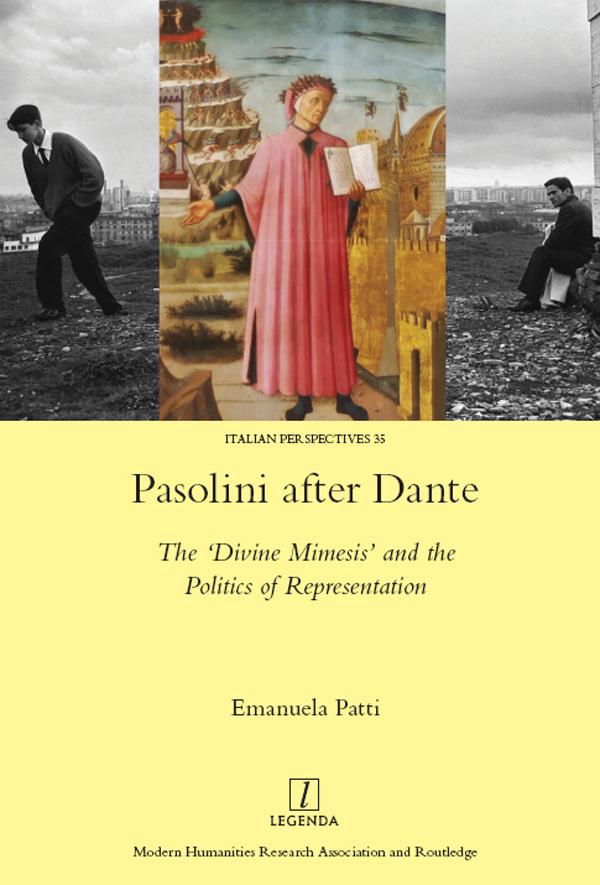
What role did Dante play in the work of Pier Paolo Pasolini (1922-1975)? His unfinished and fragmented imitation of the Comedia, La Divina Mimesis, is only one outward sign of what was a sustained dialogue with Dante on representation begun in the early 1950s. During this period, the philologists Gianfranco Contini (1912-1990) and Erich Auerbach (1892-1957) played a crucial role in Pasolini’s re-thinking of ‘represented reality’, suggesting Dante as the best literary, authorial and political model for a generation of postwar Italian writers. This emerged first as ‘Dantean realism’ in Pasolini’s prose and poetry, after Contini’s interpretation of Dante and of his plurilingualism, and then as ‘figural realism’ in his cinema, after Auerbach’s concepts of Dante’s figura and ‘mingling of styles’. Following the evolution of Pasolini’s mimetic ideal from these formative influences through to La Divina Mimesis, Emanuela Patti explores Pasolini’s politics of representation in relation to the ‘national-popular’, the ‘questione della lingua’ and the Italian post-war debates on neorealism, while also providing a new interpretation of some of his major literary and cinematic works.
Betala smidigt med kort, Klarna, Apple Pay eller Google Pay. Är du inte nöjd har du alltid 14 dagars ångerrätt. Läs mer i våra villkor. Har du några frågor, mejla oss på hello@memmo.org.
Memmo gör det enklare att plugga – var du än är i världen. Hos oss samlar du kursböcker och smarta studieverktyg på ett och samma ställe: sammanfattningar, quiz, poddar och flashcards. Och så Ted, din studiekompis som svarar på allt du undrar. Över 50 000 studenter pluggar redan här – byggt för att du ska lära dig snabbare och stressa mindre.