
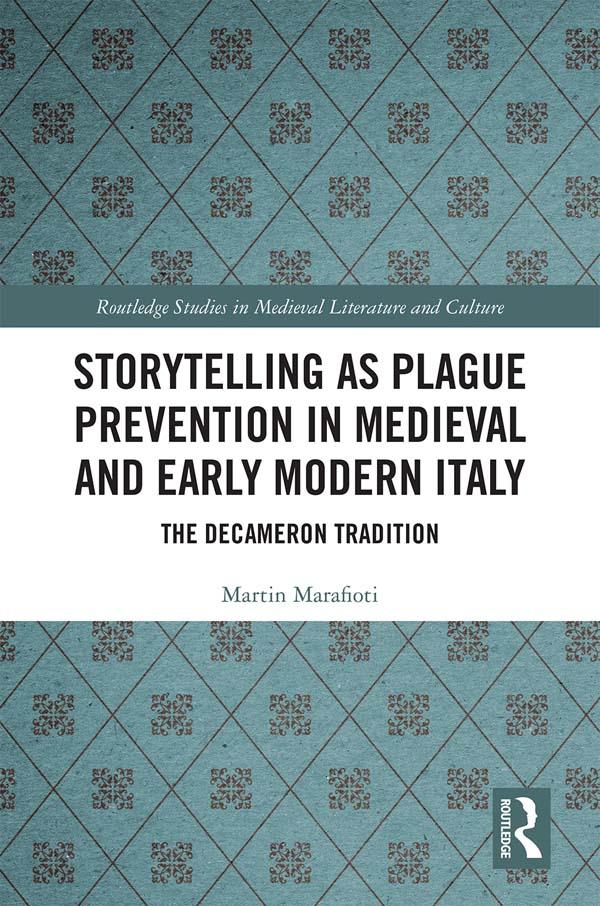
Through close readings of five Italian collections of novellas written over a 500-year period, Martin Marafioti explores the literary tradition of storytelling, and particularly its efficacy as a healing tool following traumatic visitations from the plague. In this study, Giovanni Boccaccio's Decameron provides the framework for later authors. Although Boccaccio was not the first writer to deal with pestilence or epidemics in a literary work, he was the first to unite the topos of a life-threatening context with a public health disaster like the Black Death, and certainly the first author to propose storytelling as a means of prophylaxis in times of plague. Marafioti goes on to analyze Franco Sacchetti's Trecento Novelle, Giovanni Sercambi's Novelliere, Celio Malespini's Duecento Novelle, and Francesco Argelati's Decamerone, following in its longue-durée the ups and down, structurally and thematically, of the realistic novella as a genre.
Sidor: 154
Kategori: Litteraturvetenskap & Teori
e-ISBN: 9781317049685
Fraktvikt: 1.2 kg
Skickas inom: 1-2 dagar
Betala smidigt med kort, Klarna, Apple Pay eller Google Pay. Är du inte nöjd har du alltid 14 dagars ångerrätt. Läs mer i våra villkor. Har du några frågor, mejla oss på hello@memmo.org.
Memmo gör det enklare att plugga – var du än är i världen. Hos oss samlar du kursböcker och smarta studieverktyg på ett och samma ställe: sammanfattningar, quiz, poddar och flashcards. Och så Ted, din studiekompis som svarar på allt du undrar. Över 50 000 studenter pluggar redan här – byggt för att du ska lära dig snabbare och stressa mindre.
Du kanske också gillar
Köp boken0