
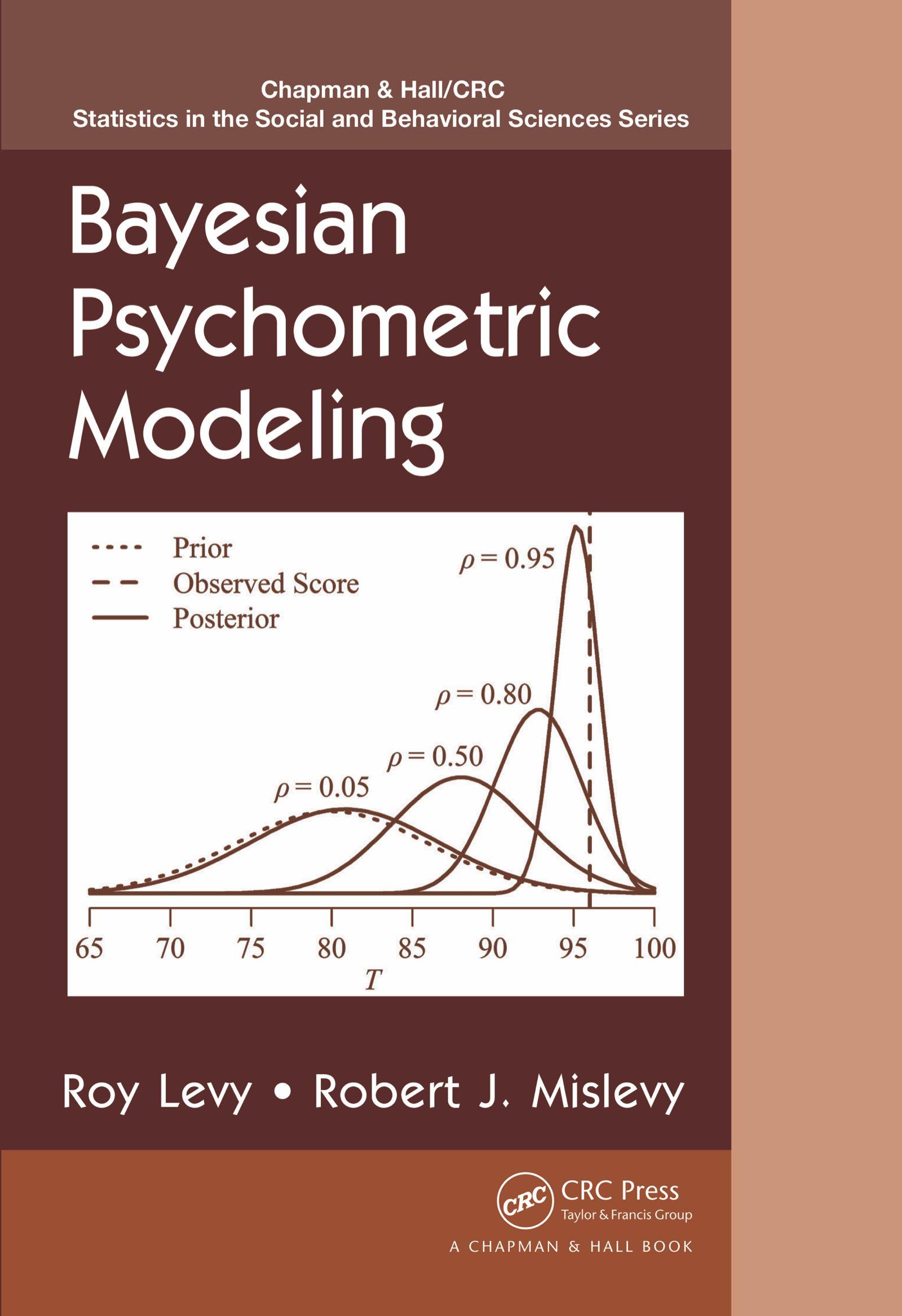
A Single Cohesive Framework of Tools and Procedures for Psychometrics and Assessment
Bayesian Psychometric Modeling presents a unified Bayesian approach across traditionally separate families of psychometric models. It shows that Bayesian techniques, as alternatives to conventional approaches, offer distinct and profound advantages in achieving many goals of psychometrics.
Adopting a Bayesian approach can aid in unifying seemingly disparate—and sometimes conflicting—ideas and activities in psychometrics. This book explains both how to perform psychometrics using Bayesian methods and why many of the activities in psychometrics align with Bayesian thinking.
The first part of the book introduces foundational principles and statistical models, including conceptual issues, normal distribution models, Markov chain Monte Carlo estimation, and regression. Focusing more directly on psychometrics, the second part covers popular psychometric models, including classical test theory, factor analysis, item response theory, latent class analysis, and Bayesian networks. Throughout the book, procedures are illustrated using examples primarily from educational assessments. A supplementary website provides the datasets, WinBUGS code, R code, and Netica files used in the examples.
Betala smidigt med kort, Klarna, Apple Pay eller Google Pay. Är du inte nöjd har du alltid 14 dagars ångerrätt. Läs mer i våra villkor. Har du några frågor, mejla oss på hello@memmo.org.
Memmo gör det enklare att plugga – var du än är i världen. Hos oss samlar du kursböcker och smarta studieverktyg på ett och samma ställe: sammanfattningar, quiz, poddar och flashcards. Och så Ted, din studiekompis som svarar på allt du undrar. Över 50 000 studenter pluggar redan här – byggt för att du ska lära dig snabbare och stressa mindre.