
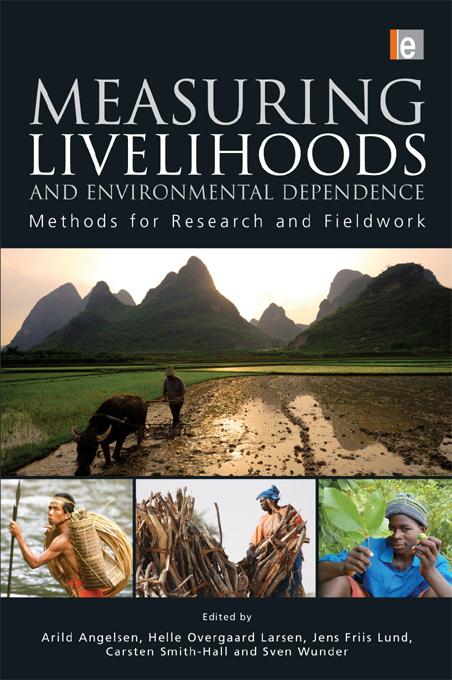
Thousands of surveys on rural livelihoods in developing countries are being done every year. Unfortunately, many suffer from weaknesses in methods and problems in implementation. Quantifying households' dependence on multiple environmental resources (forests, bush, grasslands and rivers) is particularly difficult and often simply ignored in the surveys. The results therefore do not reflect rural realities. In particular, 'the hidden harvest' from natural resources is generally too important to livelihoods for development research, policies and practice to ignore. Fieldwork using state-of-the-art methods, and in particular well-designed household questionnaires, thus becomes an imperative to adequately capture key dimensions of rural welfare.
This book describes how to do a better job when designing and implementing household and village surveys for quantitative assessment of rural livelihoods in developing countries. It covers the entire research process from planning to sharing research results. It draws on the experiences from a large global-comparative project, the Poverty Environment Network (PEN), to develop more robust and validated methods, enriched by numerous practical examples from the field. The book will provide an invaluable guide to methods and a practical handbook for students and professionals.
Betala smidigt med kort, Klarna, Apple Pay eller Google Pay. Är du inte nöjd har du alltid 14 dagars ångerrätt. Läs mer i våra villkor. Har du några frågor, mejla oss på hello@memmo.org.
Memmo gör det enklare att plugga – var du än är i världen. Hos oss samlar du kursböcker och smarta studieverktyg på ett och samma ställe: sammanfattningar, quiz, poddar och flashcards. Och så Ted, din studiekompis som svarar på allt du undrar. Över 50 000 studenter pluggar redan här – byggt för att du ska lära dig snabbare och stressa mindre.