
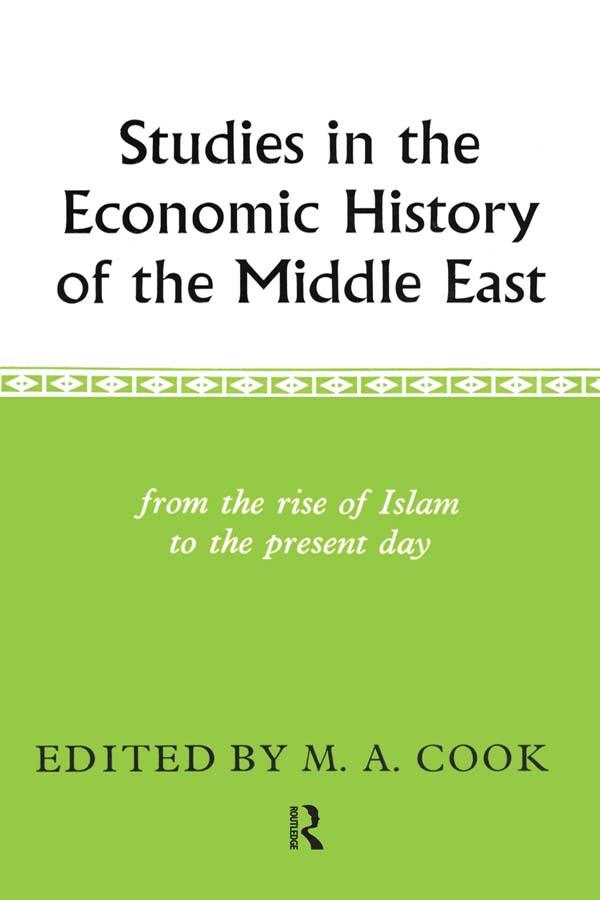
First Published in 2004. Did medieval Muslims have the concept of a 'social class'? If not, can we usefully employ the term in analysing their society? Were there such things as guilds in the medieval Middle East? Would we understand the economic de- cline of Mamluk Egypt better if we used paradigms derived from the study of the economic history of England and Italy in the fourteenth and fifteenth centuries? How much can the enormous fiscal archive of the Ottoman Empire tell us about population history? Why was the Middle East so backward, if indeed it was, compared with the rest of the Afro-Asian world in the nineteenth century? Have Iran and Iraq better prospects for economic growth than otherwise comparable countries thanks to their oil royalties? Or are these paradoxically a hindrance rather than a help? The study of the economic history of the Middle East in Islamic times is notoriously underdeveloped. This volume contains papers discussed at an international conference held at the School of Oriental and African Studies in 1967, together with three short critical essays which attempt to tie them together. Some papers are specific contributions to research, others survey wider areas. The volume is not a comprehensive history or a systematic inventory, but it is hoped that, in addition to presenting a set of papers which are interesting in themselves, it will give the reader a tolerable idea of the state of studies in the field.
Betala smidigt med kort, Klarna, Apple Pay eller Google Pay. Är du inte nöjd har du alltid 14 dagars ångerrätt. Läs mer i våra villkor. Har du några frågor, mejla oss på hello@memmo.org.
Memmo gör det enklare att plugga – var du än är i världen. Hos oss samlar du kursböcker och smarta studieverktyg på ett och samma ställe: sammanfattningar, quiz, poddar och flashcards. Och så Ted, din studiekompis som svarar på allt du undrar. Över 50 000 studenter pluggar redan här – byggt för att du ska lära dig snabbare och stressa mindre.
Du kanske också gillar
Köp boken0