
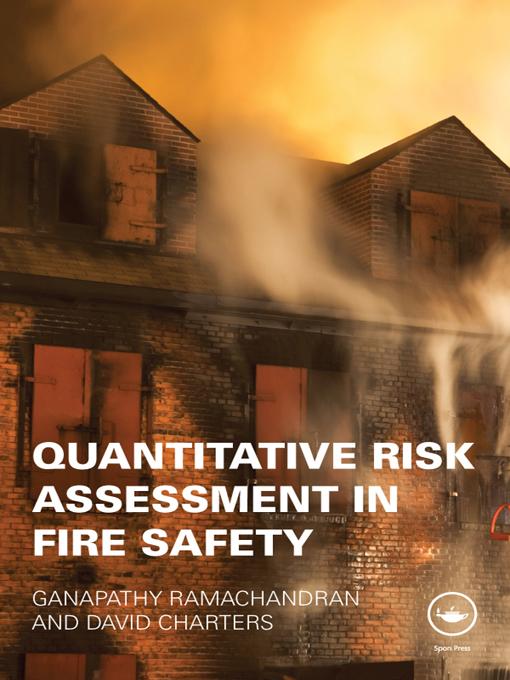
Fire safety regulations in many countries require Fire Risk Assessment to be carried out for buildings such as workplaces and houses in multiple occupation. This duty is imposed on a "Responsible Person" and also on any other persons having control of buildings in compliance with the requirements specified in the regulations.
Although regulations only require a qualitative assessment of fire risk, a quantitative assessment is an essential first step for performing cost-benefit analysis of alternative fire strategies to comply with the regulations and selecting the most cost-effective strategy. To facilitate this assessment, various qualitative, semi-quantitative and quantitative techniques of fire risk assessment, already developed, are critically reviewed in this book and some improvements are suggested.
This book is intended to be an expanded version of Part 7: Probabilistic risk assessment, 2003, a Published Document (PD) to British Standard BS 7974: 2001 on the Application of Fire Safety Engineering Principles to the Design of Buildings. Ganapathy Ramachandran and David Charters were co-authors of PD 7974 Part 7.
Quantitative Risk Assessment in Fire Safety is essential reading for consultants, academics, fire safety engineers, fire officers, building control officers and students in fire safety engineering. It also provides useful tools for fire protection economists and risk management professionals, including those involved in fire insurance underwriting.
Betala smidigt med kort, Klarna, Apple Pay eller Google Pay. Är du inte nöjd har du alltid 14 dagars ångerrätt. Läs mer i våra villkor. Har du några frågor, mejla oss på hello@memmo.org.
Memmo gör det enklare att plugga – var du än är i världen. Hos oss samlar du kursböcker och smarta studieverktyg på ett och samma ställe: sammanfattningar, quiz, poddar och flashcards. Och så Ted, din studiekompis som svarar på allt du undrar. Över 50 000 studenter pluggar redan här – byggt för att du ska lära dig snabbare och stressa mindre.