
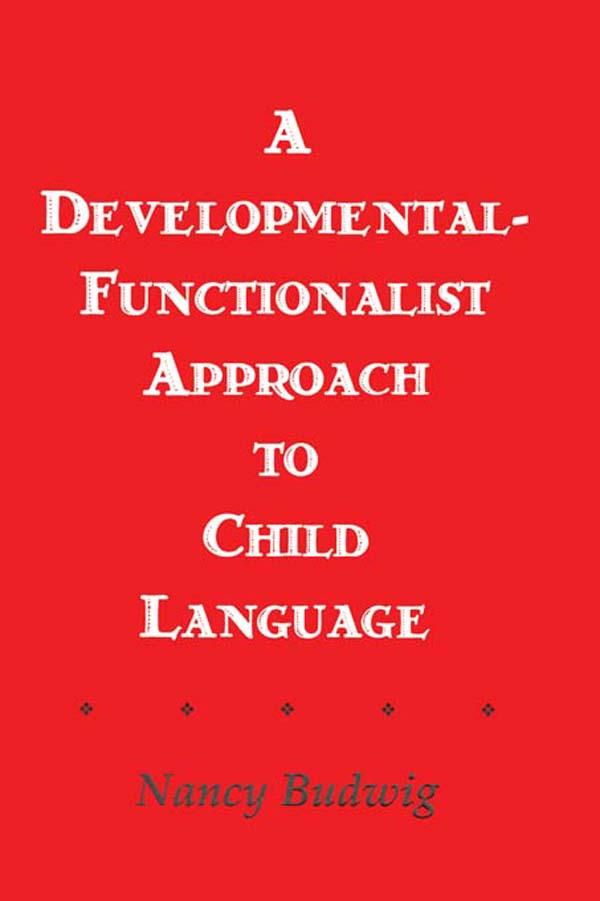
Although there has been much empirical study within what has been referred to as "functional approaches to child language," there has yet to be a major attempt to compare and contrast such proposals. In addition, much of the work carried out within child language from a functionalist perspective has not been specific with regard to the nature of the approach adopted. In attempting to fill the gap, the author of this book begins with a comparison of various functionalist approaches. By concentrating on one domain -- agentivity and control -- Budwig develops a set of research questions based on an examination of findings stemming from linguistics, psycholinguistics, and developmental psychology, and also provides an in-depth discussion of related methodological issues. In the second part of the book, she traces the development of linguistic means to refer to oneself within a developmental-functionalist perspective. Individual case studies as well as group analyses of six children in the early phases of acquiring English grammar are provided. In the last part, Budwig examines the relationship between forms and functions in development with special attention to potential generalizations about the organization and reorganization of the children's linguistic systems.
Betala smidigt med kort, Klarna, Apple Pay eller Google Pay. Är du inte nöjd har du alltid 14 dagars ångerrätt. Läs mer i våra villkor. Har du några frågor, mejla oss på hello@memmo.org.
Memmo gör det enklare att plugga – var du än är i världen. Hos oss samlar du kursböcker och smarta studieverktyg på ett och samma ställe: sammanfattningar, quiz, poddar och flashcards. Och så Ted, din studiekompis som svarar på allt du undrar. Över 50 000 studenter pluggar redan här – byggt för att du ska lära dig snabbare och stressa mindre.