
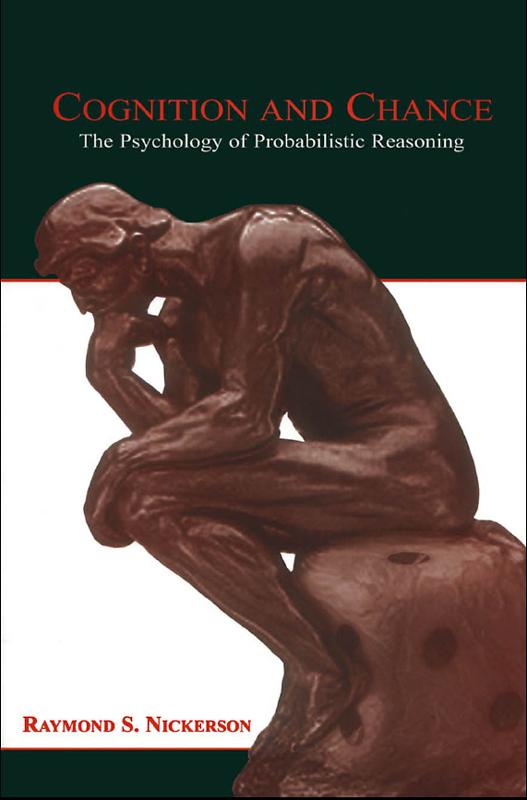
Lack of ability to think probabilistically makes one prone to a variety of irrational fears and vulnerable to scams designed to exploit probabilistic naiveté, impairs decision making under uncertainty, facilitates the misinterpretation of statistical information, and precludes critical evaluation of likelihood claims. Cognition and Chance presents an overview of the information needed to avoid such pitfalls and to assess and respond to probabilistic situations in a rational way. Dr. Nickerson investigates such questions as how good individuals are at thinking probabilistically and how consistent their reasoning under uncertainty is with principles of mathematical statistics and probability theory. He reviews evidence that has been produced in researchers' attempts to investigate these and similar types of questions. Seven conceptual chapters address such topics as probability, chance, randomness, coincidences, inverse probability, paradoxes, dilemmas, and statistics. The remaining five chapters focus on empirical studies of individuals' abilities and limitations as probabilistic thinkers. Topics include estimation and prediction, perception of covariation, choice under uncertainty, and people as intuitive probabilists.
Cognition and Chance is intended to appeal to researchers and students in the areas of probability, statistics, psychology, business, economics, decision theory, and social dilemmas.
Betala smidigt med kort, Klarna, Apple Pay eller Google Pay. Är du inte nöjd har du alltid 14 dagars ångerrätt. Läs mer i våra villkor. Har du några frågor, mejla oss på hello@memmo.org.
Memmo gör det enklare att plugga – var du än är i världen. Hos oss samlar du kursböcker och smarta studieverktyg på ett och samma ställe: sammanfattningar, quiz, poddar och flashcards. Och så Ted, din studiekompis som svarar på allt du undrar. Över 50 000 studenter pluggar redan här – byggt för att du ska lära dig snabbare och stressa mindre.