
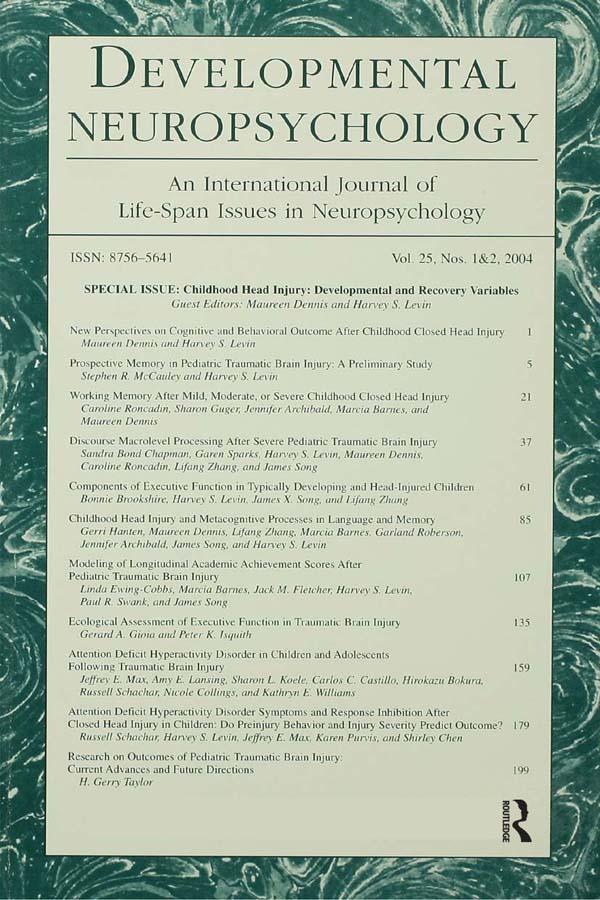
Childhood head injuries differ from adult head injuries in some significant respects. They occur against a background of ongoing physical and cognitive development. Cognitive capacities often change with time post-injury. But for children changes are affected by two processes of functional plasticity, one concerned with recovery, one with development. The impact of the injury is moderated by age/developmental stage.
In recent years there has been a new focus on the longitudinal comparison of children post-injury with appropriate control groups. Advances in neuropsychological assessment have permitted evaluation with reference to more developmentally suitable norms; expanded definitions of outcome have broadened our understanding of consequences; and neuroimaging techniques have enabled the more precise delineation of injury severity, the study of structure-function outcome relations, and the investigation of reorganization of function.
This special issue offers an overview of cutting-edge approaches to the analysis of childhood head injury.
Betala smidigt med kort, Klarna, Apple Pay eller Google Pay. Är du inte nöjd har du alltid 14 dagars ångerrätt. Läs mer i våra villkor. Har du några frågor, mejla oss på hello@memmo.org.
Memmo gör det enklare att plugga – var du än är i världen. Hos oss samlar du kursböcker och smarta studieverktyg på ett och samma ställe: sammanfattningar, quiz, poddar och flashcards. Och så Ted, din studiekompis som svarar på allt du undrar. Över 50 000 studenter pluggar redan här – byggt för att du ska lära dig snabbare och stressa mindre.