
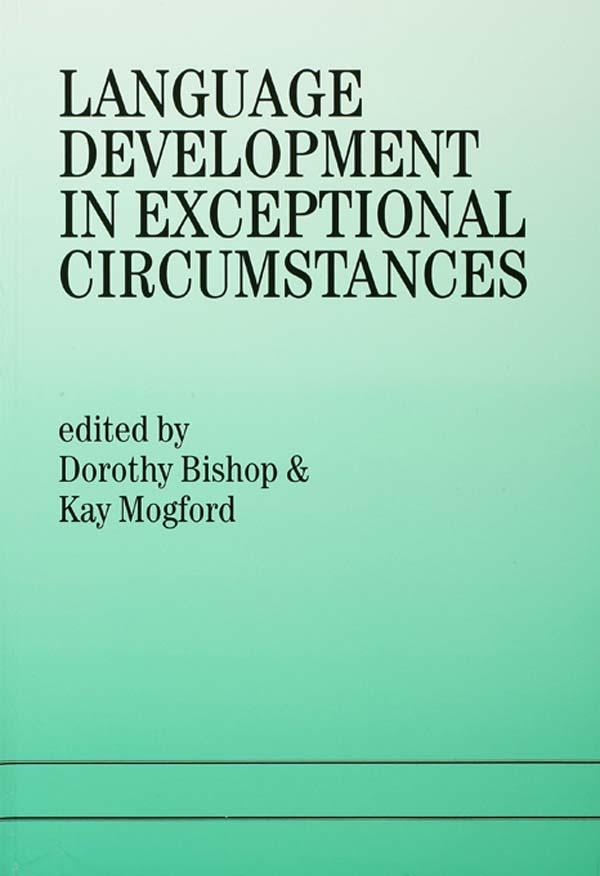
Ever since attempts were made to describe and explain normal language development, references to exceptional circumstances have been made. Variations in the conditions under which language is acquired can be regarded as natural experiments, which would not be feasible or ethical under normal circumstances. This can throw light on such questions as:
*What language input is necessary for the child to learn language?
*What is the relationship between cognition and language?
*How independent are different components of language function?
*Are there critical periods for language development?
*Can we specify necessary and sufficient conditions for language impairment? This book covers a range of exceptional circumstances including: extreme deprivation, twinship, visual and auditory impairments, autism and focal brain damage?
Written in a jargon-free style, and including a glossary of linguistic and medical terminology, the book assumes little specialist knowledge. This text is suitable for both students and practitioners in the fields of psycholinguistics, developmental and educational psychology, speech pathology, paediatrics and special education.
Betala smidigt med kort, Klarna, Apple Pay eller Google Pay. Är du inte nöjd har du alltid 14 dagars ångerrätt. Läs mer i våra villkor. Har du några frågor, mejla oss på hello@memmo.org.
Memmo gör det enklare att plugga – var du än är i världen. Hos oss samlar du kursböcker och smarta studieverktyg på ett och samma ställe: sammanfattningar, quiz, poddar och flashcards. Och så Ted, din studiekompis som svarar på allt du undrar. Över 50 000 studenter pluggar redan här – byggt för att du ska lära dig snabbare och stressa mindre.
Du kanske också gillar
Köp boken0