
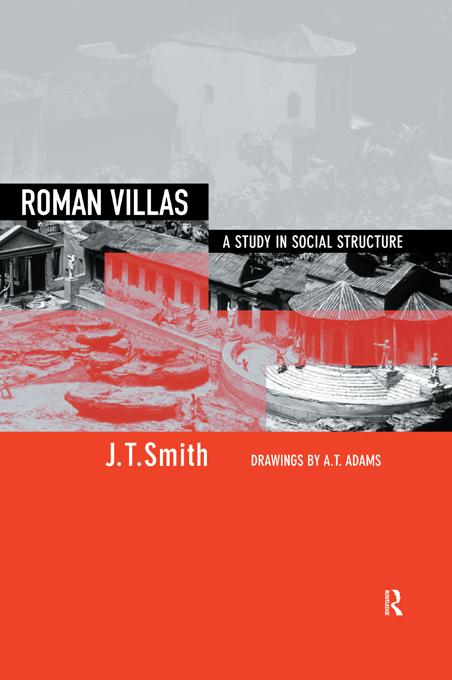
Roman Villas explores the social structures of the Roman world by analysing the plans of buildings of all sizes from slightly Romanized farms to palaces. The ways in which the rooms are grouped together; how they intercommunicate; and the ways in which individual rooms and the house are approached, reveal various social patterns, which question traditional ideas about the Roman family and household. J. T. Smith argues that virtually all houses were occupied by groups of varying composition, challenging the received wisdom that they were single family houses whose size reflected only the owner's wealth and number of servants.
Roman Villas provides a meticulously documented and scholarly examination of the relationship between the living quarters of the Roman and their social and economic development which introduces a new area in Roman studies and a corpus of material for further analysis. The inclusion of almost 500 ground plans, drawn to a uniform scale, allows the reader to compare the similarities and differences between house structure as well as effectively illustrating the arguments.
Betala smidigt med kort, Klarna, Apple Pay eller Google Pay. Är du inte nöjd har du alltid 14 dagars ångerrätt. Läs mer i våra villkor. Har du några frågor, mejla oss på hello@memmo.org.
Memmo gör det enklare att plugga – var du än är i världen. Hos oss samlar du kursböcker och smarta studieverktyg på ett och samma ställe: sammanfattningar, quiz, poddar och flashcards. Och så Ted, din studiekompis som svarar på allt du undrar. Över 50 000 studenter pluggar redan här – byggt för att du ska lära dig snabbare och stressa mindre.