
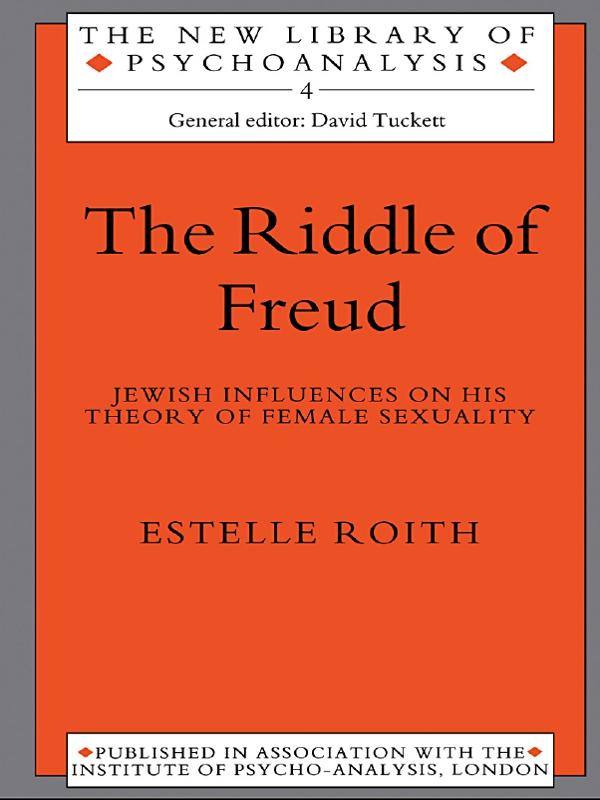
In The Riddle of Freud Estelle Roith argues that certain important elements of Judaic culture were so integral a part of Freud's personality that they became visible in his work and especially in his attitudes to and theories of femininity. Freud's formulation of femininity, which the author contends is mistaken, is seen not as a simple error but as resulting from a complex bias in which personal and social factors are interrelated. The author proposes that the considerable ambivalence experienced by Freud about his sexual, cultural, and social identity, in which both overt and covert aspects of his Jewish culture survived, could not be surmounted by him in the case of women.
Estelle Roith describes Freud's theory of femininity and its implications for psychoanalytic theories of human development and motivation in general. She examines Freud's relationships with his women disciples and also the social and political conditions that obtained for Jews of Freud's time. Finally, her book helps illuminate the reasons for Freud's emphasis on the paternal power within the Oedipus complex. It is essential reading for psychoanalysts and psychotherapists, for students of women's issues, and all those interested in Freud's impact on contemporary Western thought.
Betala smidigt med kort, Klarna, Apple Pay eller Google Pay. Är du inte nöjd har du alltid 14 dagars ångerrätt. Läs mer i våra villkor. Har du några frågor, mejla oss på hello@memmo.org.
Memmo gör det enklare att plugga – var du än är i världen. Hos oss samlar du kursböcker och smarta studieverktyg på ett och samma ställe: sammanfattningar, quiz, poddar och flashcards. Och så Ted, din studiekompis som svarar på allt du undrar. Över 50 000 studenter pluggar redan här – byggt för att du ska lära dig snabbare och stressa mindre.