
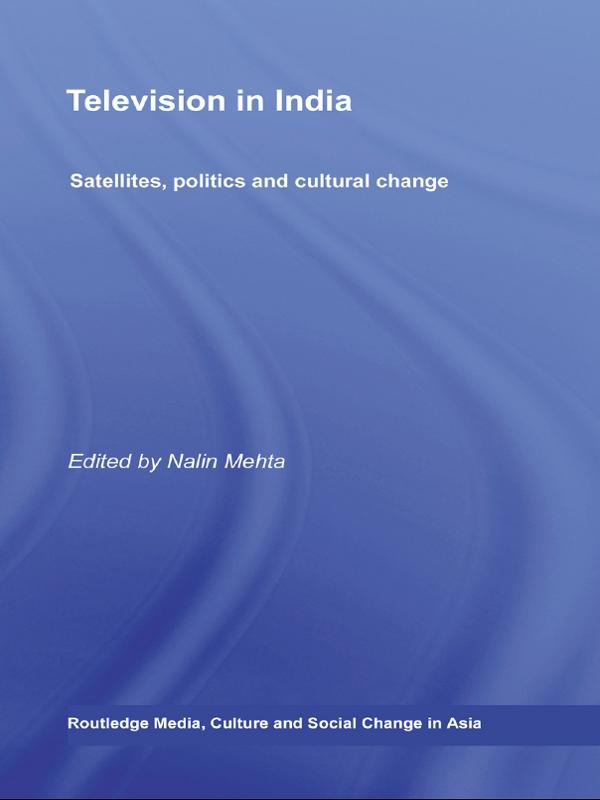
This book examines the development of television in India since the early 1990s, and its implications for Indian society more widely. Until 1991, India possessed only a single state-owned television channel, but since then there has been a rapid expansion in independent satellite channels which came as a complete break from the statist control of the past. This book explores this transformation, explaining how television, a medium that developed in the industrial West, was adapted to suit Indian conditions, and in turn has altered Indian social practices, making possible new ways of imagining identities, conducting politics and engaging with the state. In particular, satellite television initially came to India as the representative of global capitalism but it was appropriated by Indian entrepreneurs and producers who Indianized it. Considering the full gamut of Indian television - from "national" networks in English and Hindi to the state of regional language networks – this book elucidates the transformative impact of television on a range of important social practices, including politics and democracy, sport and identity formation, cinema and popular culture. Overall, it shows how the story of television in India is also the story of India's encounter with the forces of globalisation.
Betala smidigt med kort, Klarna, Apple Pay eller Google Pay. Är du inte nöjd har du alltid 14 dagars ångerrätt. Läs mer i våra villkor. Har du några frågor, mejla oss på hello@memmo.org.
Memmo gör det enklare att plugga – var du än är i världen. Hos oss samlar du kursböcker och smarta studieverktyg på ett och samma ställe: sammanfattningar, quiz, poddar och flashcards. Och så Ted, din studiekompis som svarar på allt du undrar. Över 50 000 studenter pluggar redan här – byggt för att du ska lära dig snabbare och stressa mindre.