
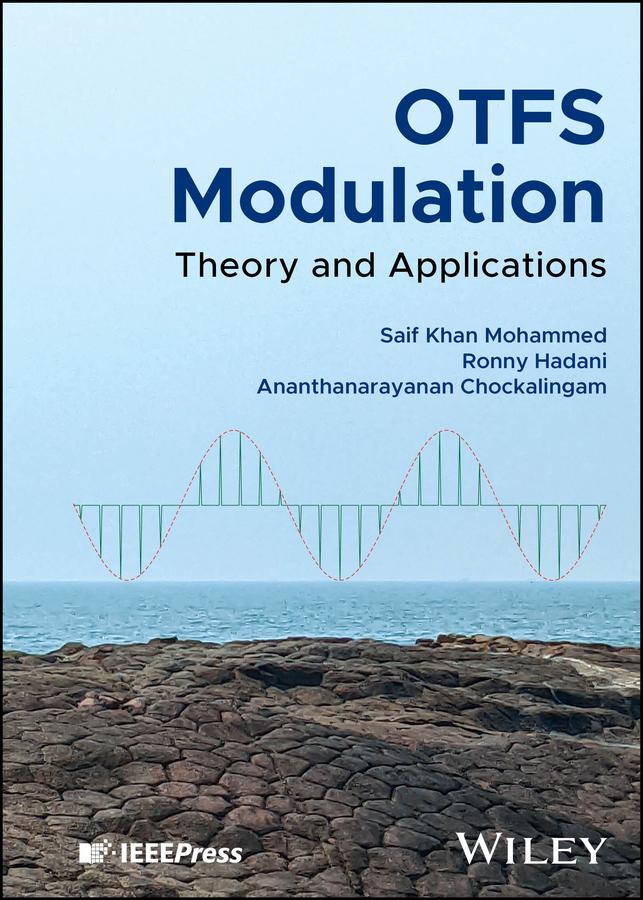
Grasp the future of wireless communication with this groundbreaking introduction
Research and development are already underway on the sixth generation (6G) of wireless communication technology. The new requirements of 6G that arise from challenging new use cases render physical layer waveforms such as CDMA and OFDM inadequate. The OTFS waveform answers these new requirements, and recent research suggests it will play a decisive role in the future of wireless communication.
OTFS Modulation: Theory and Applications provides the first ever foundational textbook that introduces this growing, state-of-the-art, field of research from first principles. Beginning with a thorough discussion of the fundamental principles of OTFS, both physical and theoretical, it rigorously situates OTFS modulation in a mathematical framework analogous to more familiar waveforms. The result is a groundbreaking contribution to communication theory and a must-have volume for wireless communication researchers.
Readers will find:
- An expert author team including the inventor of OTFS modulation
- Detailed discussion of topics including the Zak theory of linear time-varying systems, delay-Doppler communication and radar sensing, machine learning, and many more
- MATLAB™ code for OTFS transceiver implementation
OTFS Modulation: Theory and Applications is ideal for researchers, engineers, graduate and advanced undergraduate students, and standardization professionals working with wireless communication, signal processing, and radar sensing.
Betala smidigt med kort, Klarna, Apple Pay eller Google Pay. Är du inte nöjd har du alltid 14 dagars ångerrätt. Läs mer i våra villkor. Har du några frågor, mejla oss på hello@memmo.org.
Memmo gör det enklare att plugga – var du än är i världen. Hos oss samlar du kursböcker och smarta studieverktyg på ett och samma ställe: sammanfattningar, quiz, poddar och flashcards. Och så Ted, din studiekompis som svarar på allt du undrar. Över 50 000 studenter pluggar redan här – byggt för att du ska lära dig snabbare och stressa mindre.