
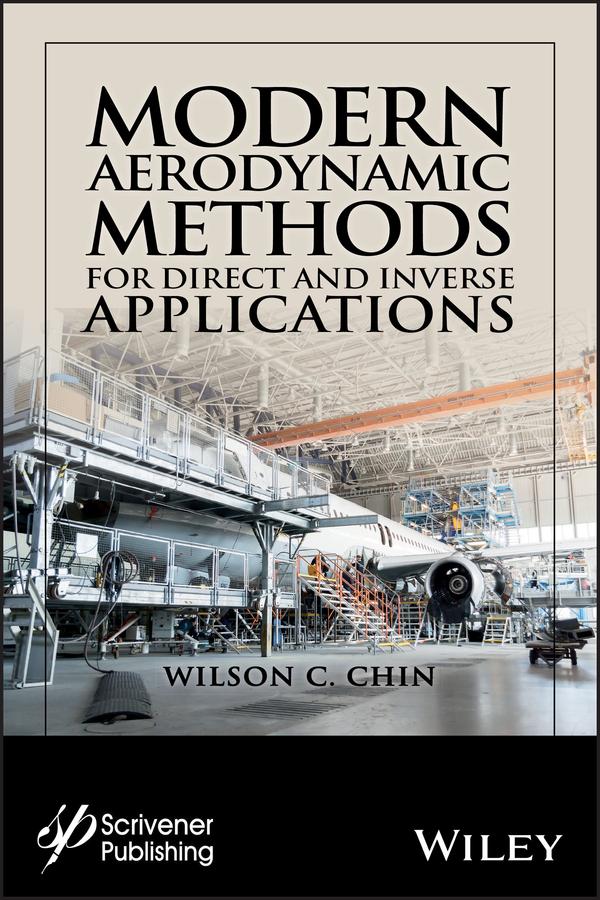
A powerful new monograph from an aerodynamicist reviewing modern conventional aerodynamic approaches, this volume covers aspects of subsonic, transonic and supersonic flow, inverse problems, shear flow analysis, jet engine power addition, engine and airframe integration, and other areas, providing readers with the tools needed to evaluate their own ideas and to implement the newer methods suggested in this book.
This new book, by a prolific fluid-dynamicist and mathematician who has published more than twenty research monographs, represents not just another contribution to aerodynamics, but a book that raises serious questions about traditionally accepted approaches and formulations, providing new methods that solve longstanding problems of importance to the industry. While both conventional and newer ideas are discussed, the presentations are readable and geared to advanced undergraduates with exposure to elementary differential equations and introductory aerodynamics principles. Readers are introduced to fundamental algorithms (with Fortran source code) for basic applications, such as subsonic lifting airfoils, transonic supercritical flows utilizing mixed differencing, models for inviscid shear flow aerodynamics, and so on. These are models they can extend to include newer effects developed in the second half of the book. Many of the newer methods have appeared over the years in various journals and are now presented with deeper perspective and integration.
This book helps readers approach the literature more critically. Rather than simply understanding an approach, for instance, the powerful "type differencing" behind transonic analysis, or the rationale behind "conservative" formulations, or the use of Euler equation methods for shear flow analysis when they are unnecessary, the author guides and motivates the user to ask why and why not and what if. And often, more powerful methods can be developed using no more than simple mathematical manipulations. For example, Cauchy-Riemann conditions, which are powerful tools in subsonic airfoil theory, can be readily extended to handle compressible flows with shocks, rotational flows, and even three-dimensional wing flowfields, in a variety of applications, to produce powerful formulations that address very difficult problems. This breakthrough volume is certainly a "must have" on every engineer's bookshelf.
Betala smidigt med kort, Klarna, Apple Pay eller Google Pay. Är du inte nöjd har du alltid 14 dagars ångerrätt. Läs mer i våra villkor. Har du några frågor, mejla oss på hello@memmo.org.
Memmo gör det enklare att plugga – var du än är i världen. Hos oss samlar du kursböcker och smarta studieverktyg på ett och samma ställe: sammanfattningar, quiz, poddar och flashcards. Och så Ted, din studiekompis som svarar på allt du undrar. Över 50 000 studenter pluggar redan här – byggt för att du ska lära dig snabbare och stressa mindre.