
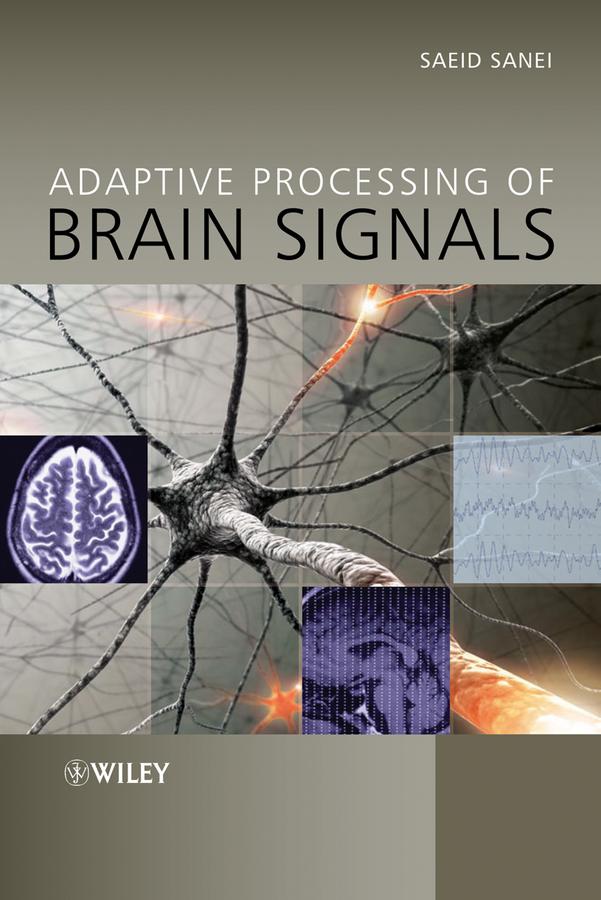
In this book, the field of adaptive learning and processing is extended to arguably one of its most important contexts which is the understanding and analysis of brain signals. No attempt is made to comment on physiological aspects of brain activity; instead, signal processing methods are developed and used to assist clinical findings. Recent developments in detection, estimation and separation of diagnostic cues from different modality neuroimaging systems are discussed.
These include constrained nonlinear signal processing techniques which incorporate sparsity, nonstationarity, multimodal data, and multiway techniques.
Key features:
- Covers advanced and adaptive signal processing techniques for the processing of electroencephalography (EEG) and magneto-encephalography (MEG) signals, and their correlation to the corresponding functional magnetic resonance imaging (fMRI)
- Provides advanced tools for the detection, monitoring, separation, localising and understanding of functional, anatomical, and physiological abnormalities of the brain
- Puts a major emphasis on brain dynamics and how this can be evaluated for the assessment of brain activity in various states such as for brain-computer interfacing emotions and mental fatigue analysis
- Focuses on multimodal and multiway adaptive processing of brain signals, the new direction of brain signal research
Betala smidigt med kort, Klarna, Apple Pay eller Google Pay. Är du inte nöjd har du alltid 14 dagars ångerrätt. Läs mer i våra villkor. Har du några frågor, mejla oss på hello@memmo.org.
Memmo gör det enklare att plugga – var du än är i världen. Hos oss samlar du kursböcker och smarta studieverktyg på ett och samma ställe: sammanfattningar, quiz, poddar och flashcards. Och så Ted, din studiekompis som svarar på allt du undrar. Över 50 000 studenter pluggar redan här – byggt för att du ska lära dig snabbare och stressa mindre.