
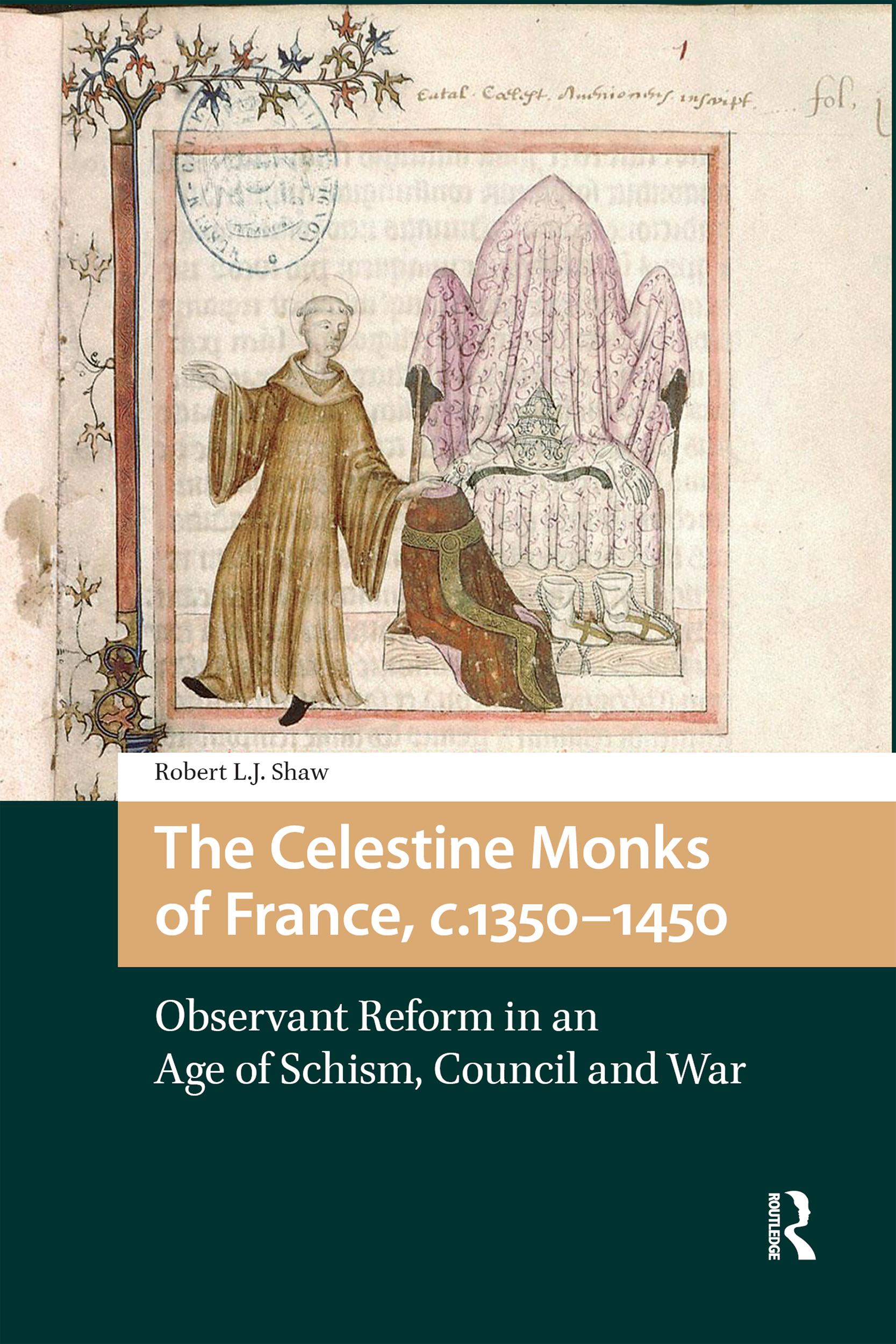
The Celestine monks of France represent one of the least studied monastic reform movements of the late Middle Ages, and yet also one of the most culturally impactful. Their order - an austere Italian Benedictine reform of the late thirteenth century, which came be known after the papal name of their founder, Celestine V (St Peter of Murrone) - arrived in France in 1300. After a period of marginal growth, they flourished in the region from the mid-fourteenth century, founding thirteen new houses over the next hundred years, taking their total to seventeen by 1450. Not only did the French Celestines expand, they gained a distinctive character that separated them from their Italian brothers. More urban, better connected with both aristocratic and bourgeois society, and yet still rigorous and reformist, they characterised themselves as the 'Observant' wing of their order, having gained self-government for their provincial congregation in 1380 following the arrival of the Great Western Schism (1378-1417). But, as Robert L.J. Shaw argues, their importance runs beyond monastic reform: the late medieval French Celestines are a mirror of the political, intellectual, and Christian reform culture of their age. Within a France torn by war and a Church divided by schism, the French Celestines represented hope for renewal, influencing royal presentation, lay religion, and some of the leading French intellectuals of the period, including Jean Gerson.
Betala smidigt med kort, Klarna, Apple Pay eller Google Pay. Är du inte nöjd har du alltid 14 dagars ångerrätt. Läs mer i våra villkor. Har du några frågor, mejla oss på hello@memmo.org.
Memmo gör det enklare att plugga – var du än är i världen. Hos oss samlar du kursböcker och smarta studieverktyg på ett och samma ställe: sammanfattningar, quiz, poddar och flashcards. Och så Ted, din studiekompis som svarar på allt du undrar. Över 50 000 studenter pluggar redan här – byggt för att du ska lära dig snabbare och stressa mindre.
Du kanske också gillar
Köp boken0