
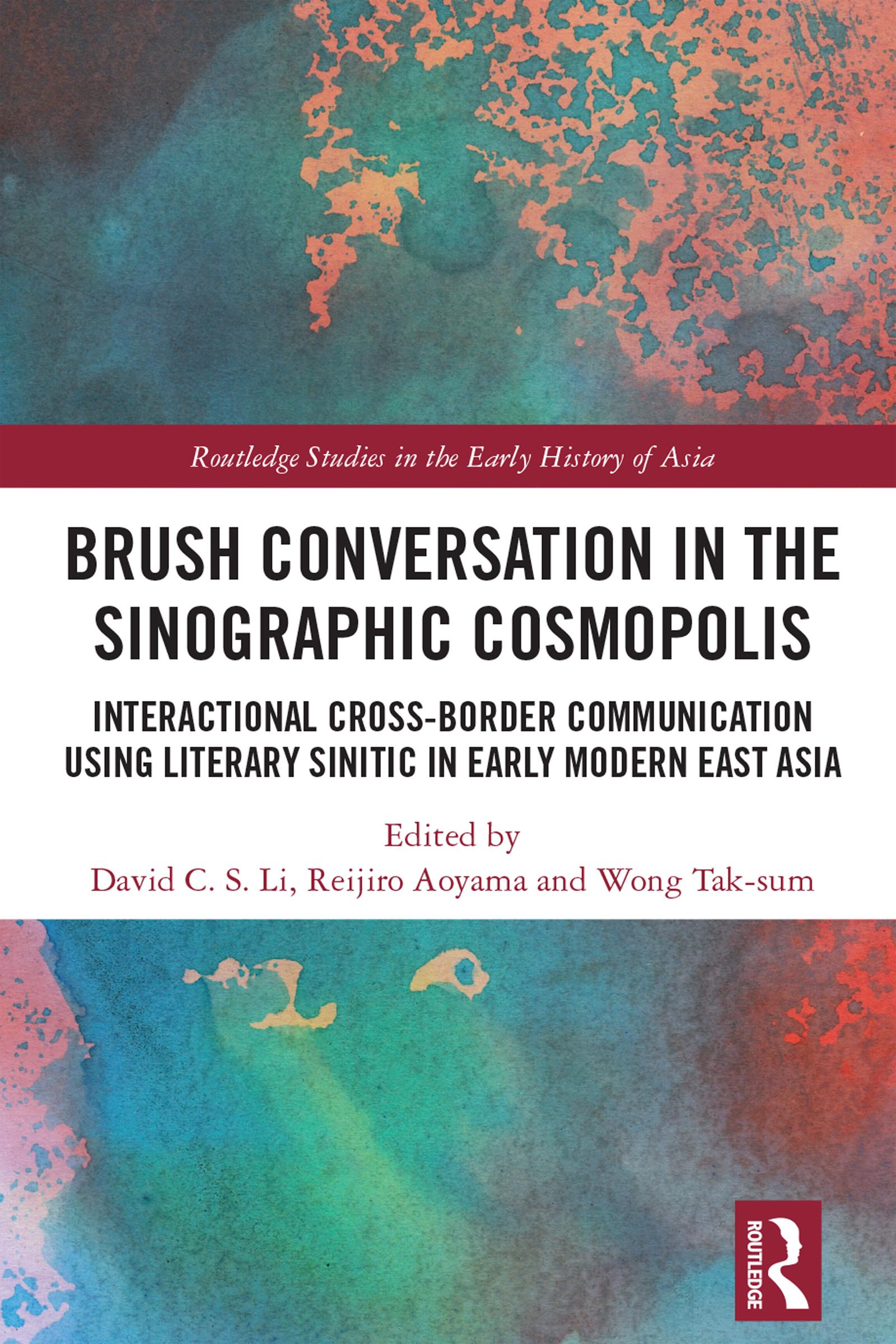
For hundreds of years until the 1900s, in today’s China, Japan, North and South Korea, and Vietnam, literati of Classical Chinese or Literary Sinitic (wényán 文言) could communicate in writing interactively, despite not speaking each other’s languages.
This book outlines the historical background of, and the material conditions that led to, widespread literacy development in premodern and early modern East Asia, where reading and writing for formal purposes was conducted in Literary Sinitic. To exemplify how ‘silent conversation’ or ‘brush-assisted conversation’ is possible through writing-mediated brushed interaction, synchronously face-to-face, this book presents contextualized examples from recurrent contexts involving (i) boat drifters; (ii) traveling literati; and (iii) diplo- matic envoys. Where profound knowledge of classical canons and literary works in Sinitic was a shared attribute of the brush-talkers concerned, their brush-talk would characteristically be intertwined with poetic improvisation.
Being the first monograph in English to address this fascinating lingua-cultural practice and cross-border communication phenomenon, which was possibly sui generis in Sinographic East Asia, it will be of interest to students of not only East Asian languages and linguistics, history, international relations, and diplomacy, but also (historical) pragmatics, sociolinguistics, sociology of language, scripts and writing systems, and cultural and linguistic anthropology.
Betala smidigt med kort, Klarna, Apple Pay eller Google Pay. Är du inte nöjd har du alltid 14 dagars ångerrätt. Läs mer i våra villkor. Har du några frågor, mejla oss på hello@memmo.org.
Memmo gör det enklare att plugga – var du än är i världen. Hos oss samlar du kursböcker och smarta studieverktyg på ett och samma ställe: sammanfattningar, quiz, poddar och flashcards. Och så Ted, din studiekompis som svarar på allt du undrar. Över 50 000 studenter pluggar redan här – byggt för att du ska lära dig snabbare och stressa mindre.