
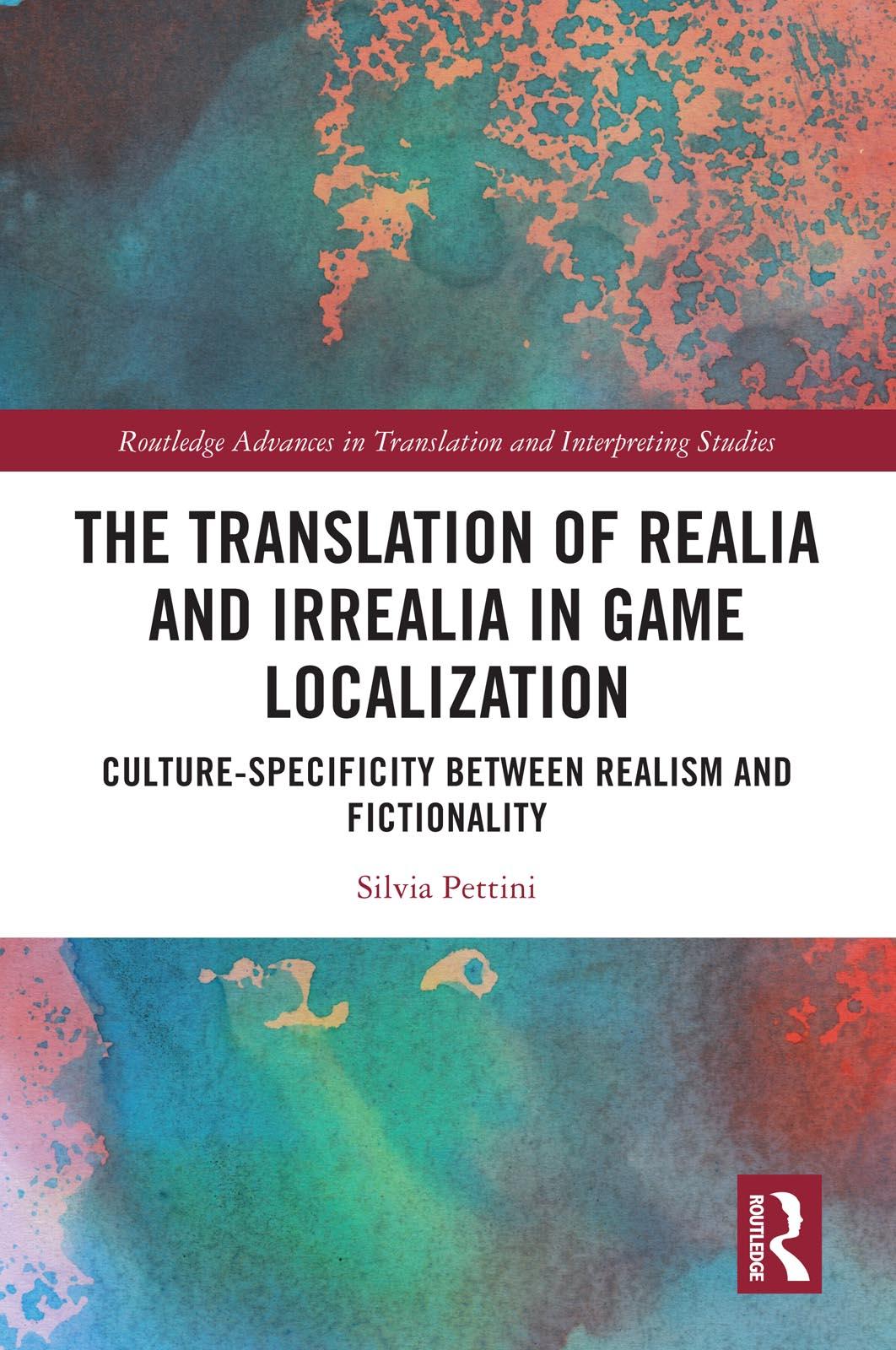
This book explores the impact of a video game’s degree of realism or fictionality on its linguistic dimensions, investigating the challenges and strategies for translating realia and irrealia, the interface of the real world and the game world where culture-specificity manifests itself.
The volume outlines the key elements in the translation of video games, such as textual non-linearity, multitextuality, and playability, and introduces the theoretical framework used to determine a game’s respective degree of realism or fictionality. Pettini applies an interdisciplinary approach drawing on video game research and Descriptive Translation Studies to the linguistic and translational analysis of in-game dialogs in English-Italian and English-Spanish language pairs from a corpus of three war video games. This approach allows for an in-depth look at the localization challenges posed by the varying degree of realism and fictionality across video games and the different strategies translators employ in response to these challenges. A final chapter offers a comparative analysis of the three games and subsequently avenues for further research on the role of culture-specificity in game localization.
This book is key reading for students and scholars interested in game localization, audiovisual translation studies, and video game research.
Betala smidigt med kort, Klarna, Apple Pay eller Google Pay. Är du inte nöjd har du alltid 14 dagars ångerrätt. Läs mer i våra villkor. Har du några frågor, mejla oss på hello@memmo.org.
Memmo gör det enklare att plugga – var du än är i världen. Hos oss samlar du kursböcker och smarta studieverktyg på ett och samma ställe: sammanfattningar, quiz, poddar och flashcards. Och så Ted, din studiekompis som svarar på allt du undrar. Över 75 000 studenter pluggar redan här – byggt för att du ska lära dig snabbare och stressa mindre.