
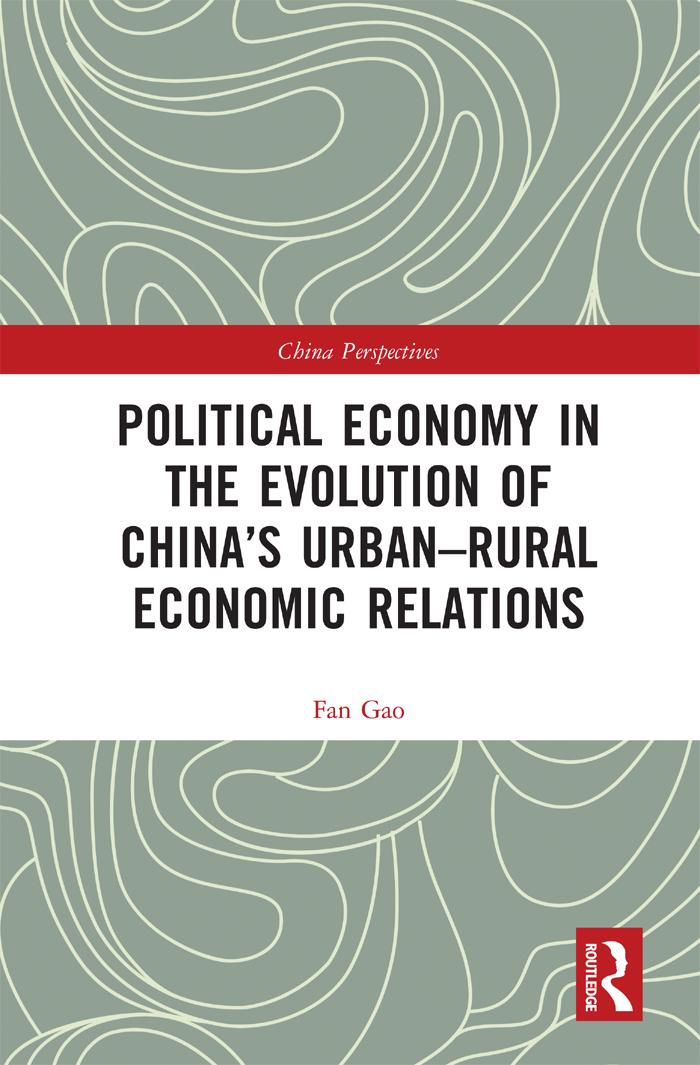
This book investigates the trajectory and evolutionary mechanisms of China’s urban–rural economic relationships, seeking to explore how a developing socialist country can attain sustainable development and common prosperity.
Grounded in a deep literature review and a practical analysis of real-world conditions in China, the study challenges the dual economy theory of development economics that has prevailed in discussion of Chinese urban–rural economic relationships and puts forward an alternative analytical framework based on political economy. Considering the role political and social factors have played in China’s economic development since 1949, the author divides the evolution of China’s urban–rural economic relationship into two stages. In the first stage the relationship is seen to be a “separated” one, a situation that led to several repercussions; but the reform and opening-up of the late 1970s marked a turning point leading to a second stage featured by “imbalanced integration”. Through empirical research, the book analyses the momentum, economic effects, and problems of this turn, thereby envisaging an upgraded stage marked out by “collaborative integration”, integral to further economic development and a more prosperous society in all respects.
The title will appeal to scholars and student studying political economy, urban–rural economic relationships, development economics, and the Chinese economy.
Betala smidigt med kort, Klarna, Apple Pay eller Google Pay. Är du inte nöjd har du alltid 14 dagars ångerrätt. Läs mer i våra villkor. Har du några frågor, mejla oss på hello@memmo.org.
Memmo gör det enklare att plugga – var du än är i världen. Hos oss samlar du kursböcker och smarta studieverktyg på ett och samma ställe: sammanfattningar, quiz, poddar och flashcards. Och så Ted, din studiekompis som svarar på allt du undrar. Över 50 000 studenter pluggar redan här – byggt för att du ska lära dig snabbare och stressa mindre.