
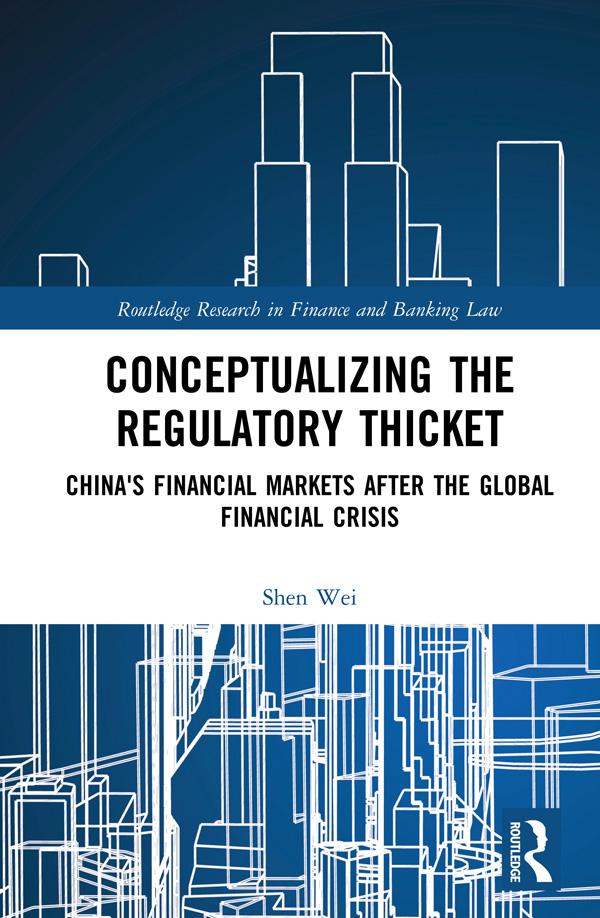
This book examines the regulatory framework, regulatory objectives, regulatory logics, regulatory instruments, regulatory failures, and regulatory responses in China’s financial market after the global financial crisis. The book provides an in-depth analysis of China’s contemporary financial regulatory system, focusing on risks, regulation, and policies in practice. By drawing on public and private interest theories relating to financial regulation, the book contends that the controlled development of the banking sector, and the financial sector generally, has transformed China’s banks into more market-oriented institutions and increased public sector growth. However, China’s financial market and financial regulation have some inherent weaknesses and deficiencies. This book also offers insights into how this can be improved or adapted to minimize systemic risks in China’s financial sector. This book tries to prove that financial regulation is not just a vehicle for maintaining efficient financial markets but a primary tool through which the Chinese government achieves its political and economic objectives. More fundamentally, according to the law and finance theory, strong market and vibrant judicial systems are needed to further modernize China’s financial markets and market economy.
The book will be a useful reference for anyone interested in learning from the Chinese experience.
Betala smidigt med kort, Klarna, Apple Pay eller Google Pay. Är du inte nöjd har du alltid 14 dagars ångerrätt. Läs mer i våra villkor. Har du några frågor, mejla oss på hello@memmo.org.
Memmo gör det enklare att plugga – var du än är i världen. Hos oss samlar du kursböcker och smarta studieverktyg på ett och samma ställe: sammanfattningar, quiz, poddar och flashcards. Och så Ted, din studiekompis som svarar på allt du undrar. Över 50 000 studenter pluggar redan här – byggt för att du ska lära dig snabbare och stressa mindre.