
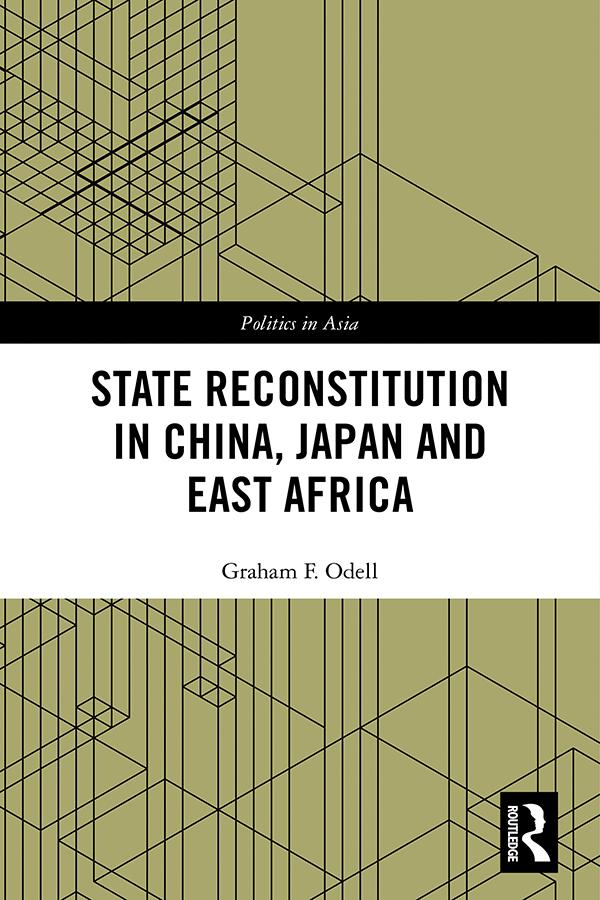
Presented through an investigation of Sengoku Japan and Republican China, this book proposes an innovative explanation of state formation that focuses on ideational and geographic factors.
This study addresses the question; why are some collapsed states able to reconstitute themselves where others have not? Graham F. Odell employs two cases of successful state reconstitution – Republican China (1912-1949) and Sengoku Japan (1477-1615) – to derive a new theoretical framework around this question. These cases are distinct across several significant factors, making them ideal for a research design that seeks to formulate an original theoretical explanation for a phenomenon. Taken together, these two periods of Chinese and Japanese history are paradigmatic cases of state collapse and reconstitution and thus intrinsically compelling to the study of state formation. By developing a new theory of successful state reconstitution through emphasizing the roles of ideology, political symbolism and the geographical distribution of social power, this text provides an answer to the question that has not only scholarly and practical implications, but also a wide geographical applicability.
This book will be key reading for scholars interested in matters of international politics, political science, and state formation, especially in East Asia.
Betala smidigt med kort, Klarna, Apple Pay eller Google Pay. Är du inte nöjd har du alltid 14 dagars ångerrätt. Läs mer i våra villkor. Har du några frågor, mejla oss på hello@memmo.org.
Memmo gör det enklare att plugga – var du än är i världen. Hos oss samlar du kursböcker och smarta studieverktyg på ett och samma ställe: sammanfattningar, quiz, poddar och flashcards. Och så Ted, din studiekompis som svarar på allt du undrar. Över 50 000 studenter pluggar redan här – byggt för att du ska lära dig snabbare och stressa mindre.