
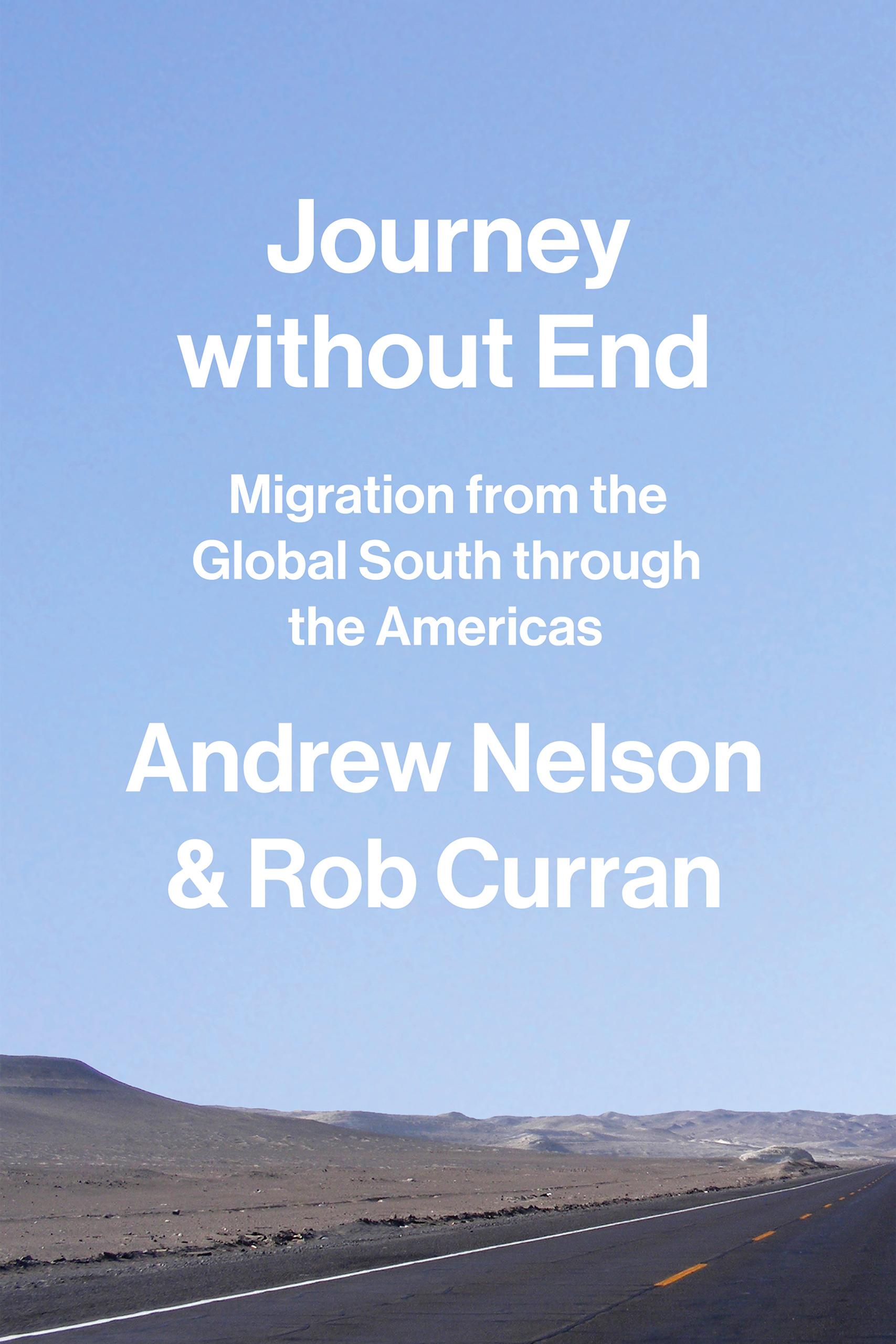
Journey without End chronicles the years-long journey of "extracontinentales"—African and South Asian migrants moving through Latin America toward the United States. Based on five years of collaborative research between a journalist and an anthropologist, this book makes an engrossing, sometimes surreal, narrative-driven critique of how state-level immigration policy fails extracontinental migrants.
The book begins with Kidane, an Eritrean migrant who has left his pregnant wife behind to make the four-year trip to North America; it then picks up the natural disaster–riddled voyage of Roshan and Kamala Dhakal from Nepal to Ecuador; and it continues to the trials of Cameroonian exile Jane Mtebe, who becomes trapped in a bizarre beachside resort town on the edge of the Darién Gap—the gateway from South to Central America.
Journey without End follows these migrants as their fitful voyages put them in a semi-permanent state of legal and existential liminality. Mercurial policy creates profit opportunities that transform migration bottlenecks—Quito's tourist district, a Colombian beachside resort, Panama's Darién Gap, and a Mexican border town—into spontaneous migration-oriented spaces rife with racial, gender, and class exploitation. Throughout this struggle, migrant solidarity allows for occasional glimpses of subaltern cosmopolitanism and the possibility of mobile futures.
The book begins with Kidane, an Eritrean migrant who has left his pregnant wife behind to make the four-year trip to North America; it then picks up the natural disaster–riddled voyage of Roshan and Kamala Dhakal from Nepal to Ecuador; and it continues to the trials of Cameroonian exile Jane Mtebe, who becomes trapped in a bizarre beachside resort town on the edge of the Darién Gap—the gateway from South to Central America.
Journey without End follows these migrants as their fitful voyages put them in a semi-permanent state of legal and existential liminality. Mercurial policy creates profit opportunities that transform migration bottlenecks—Quito's tourist district, a Colombian beachside resort, Panama's Darién Gap, and a Mexican border town—into spontaneous migration-oriented spaces rife with racial, gender, and class exploitation. Throughout this struggle, migrant solidarity allows for occasional glimpses of subaltern cosmopolitanism and the possibility of mobile futures.
Betala smidigt med kort, Klarna, Apple Pay eller Google Pay. Är du inte nöjd har du alltid 14 dagars ångerrätt. Läs mer i våra villkor. Har du några frågor, mejla oss på hello@memmo.org.
Memmo gör det enklare att plugga – var du än är i världen. Hos oss samlar du kursböcker och smarta studieverktyg på ett och samma ställe: sammanfattningar, quiz, poddar och flashcards. Och så Ted, din studiekompis som svarar på allt du undrar. Över 50 000 studenter pluggar redan här – byggt för att du ska lära dig snabbare och stressa mindre.
Du kanske också gillar
Köp boken0