
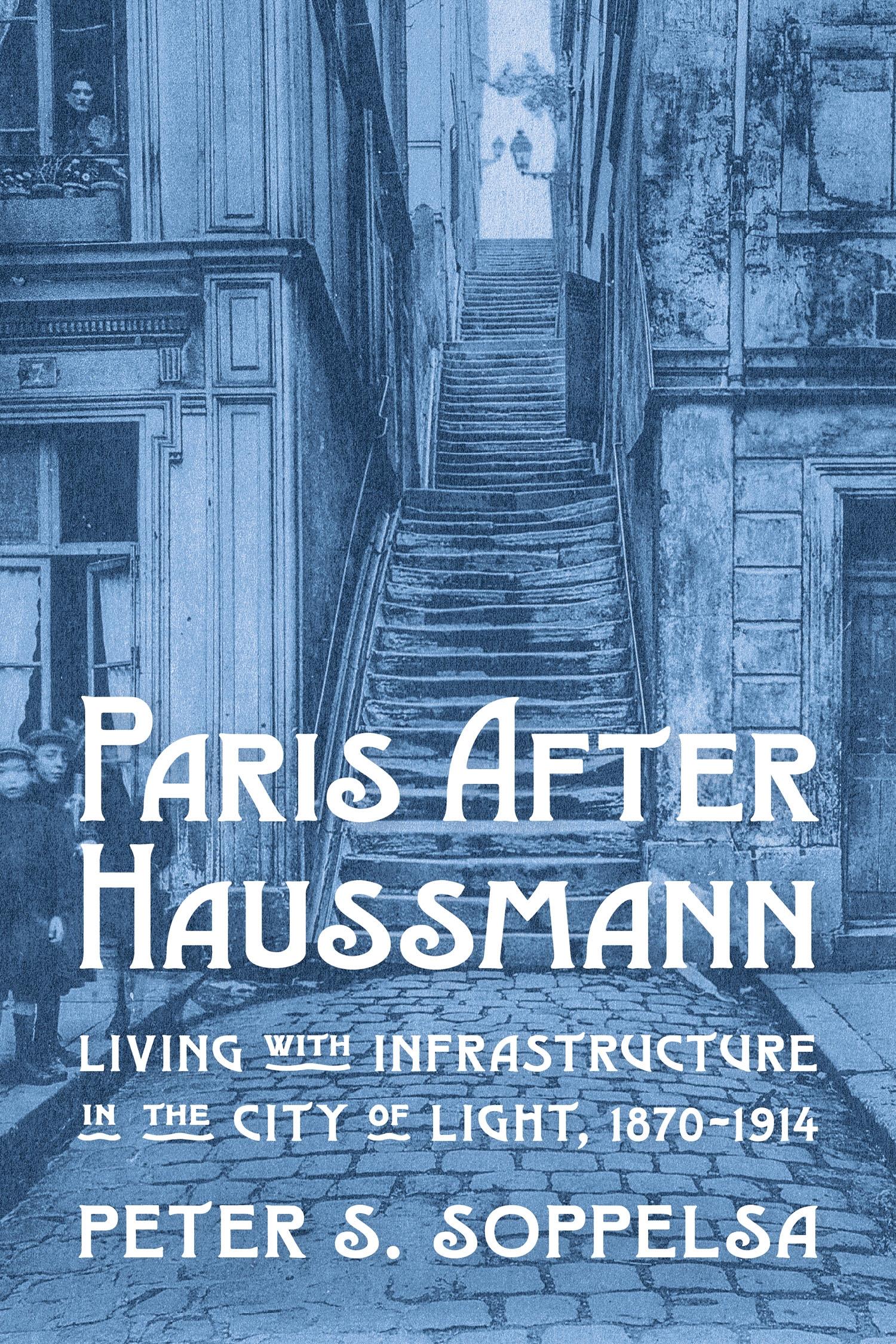
Modern Paris is often hailed as a capital of urban infrastructure. Baron Georges-Eugène Haussmann’s rebuilding of Paris in 1853–1870, branded “Haussmannization,” helped define urban modernity for cities worldwide. But even as infrastructures expanded and modernized, some Parisians were left behind: as late as 1928, 18 percent of houses still lacked direct sewerage. Haussmannization often hid infrastructures behind walls and floors, under streets, or in peripheral districts. In the forty years after 1870, a period that Peter Soppelsa calls “secondary Haussmannization,” Parisians inverted them—revealed their hidden components to scrutinize their workings and costs for society, environment, and health—and in turn politicized them. Drawing on French government archives, engineers’ maps, the illustrated press, and a collection of over 100 photographic postcards, Soppelsa charts the diverse embodied, emotional, and everyday experiences of living with expanding urban infrastructures—streets, housing, tramways, subways, the water supply, sewers, and rivers—in Paris from 1870 to 1914. Parisians learned that infrastructures were not simply technical solutions for the social and environmental problems of city life but could also bring about new dangers and dependencies.
Betala smidigt med kort, Klarna, Apple Pay eller Google Pay. Är du inte nöjd har du alltid 14 dagars ångerrätt. Läs mer i våra villkor. Har du några frågor, mejla oss på hello@memmo.org.
Memmo gör det enklare att plugga – var du än är i världen. Hos oss samlar du kursböcker och smarta studieverktyg på ett och samma ställe: sammanfattningar, quiz, poddar och flashcards. Och så Ted, din studiekompis som svarar på allt du undrar. Över 75 000 studenter pluggar redan här – byggt för att du ska lära dig snabbare och stressa mindre.
Du kanske också gillar
Köp boken0