
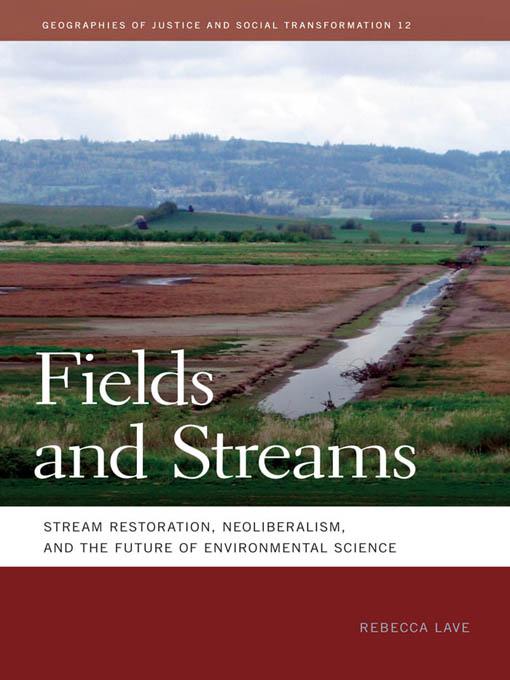
Examining the science of stream restoration, Rebecca Lave argues that the neoliberal emphasis on the privatization and commercialization of knowledge has fundamentally changed the way that science is funded, organized, and viewed in the United States.
Stream restoration science and practice is in a startling state. The most widely respected expert in the field, Dave Rosgen, is a private consultant with relatively little formal scientific training. Since the mid-1990s, many academic and federal agency–based scientists have denounced Rosgen as a charlatan and a hack. Despite this, Rosgen’s Natural Channel Design approach, classification system, and short-course series are not only accepted but are viewed as more legitimate than academically produced knowledge and training. Rosgen’s methods are now promoted by federal agencies including the Environmental Protection Agency, the U.S. Forest Service, the U.S. Fish and Wildlife Service, and the Natural Resources Conservation Service, as well as by resource agencies in dozens of states.
Drawing on the work of Pierre Bourdieu, Lave demonstrates that the primary cause of Rosgen’s success is neither the method nor the man but is instead the assignment of a new legitimacy to scientific claims developed outside the academy, concurrent with academic scientists’ decreasing ability to defend their turf. What is at stake in the Rosgen wars, argues Lave, is not just the ecological health of our rivers and streams but the very future of environmental science.
Betala smidigt med kort, Klarna, Apple Pay eller Google Pay. Är du inte nöjd har du alltid 14 dagars ångerrätt. Läs mer i våra villkor. Har du några frågor, mejla oss på hello@memmo.org.
Memmo gör det enklare att plugga – var du än är i världen. Hos oss samlar du kursböcker och smarta studieverktyg på ett och samma ställe: sammanfattningar, quiz, poddar och flashcards. Och så Ted, din studiekompis som svarar på allt du undrar. Över 50 000 studenter pluggar redan här – byggt för att du ska lära dig snabbare och stressa mindre.