
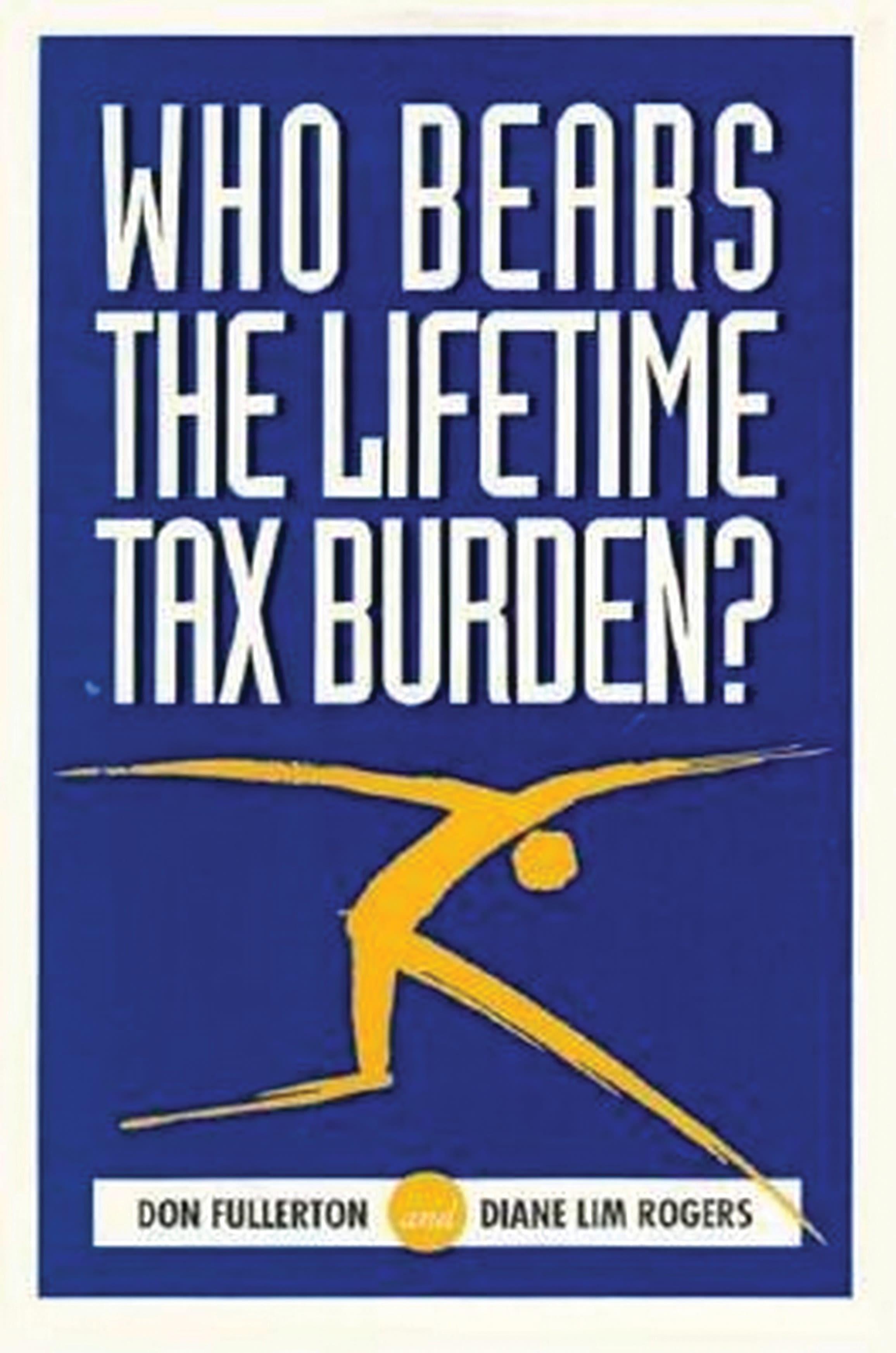
Debates about tax policy arise every year in Washington, and legislative changes occur almost as often. In just the past decade, corporate tax burdens were dramatically reduced and then subsequently increased. But who really bears the burden of taxation? Finding a satisfactory way to address this question remains one of the biggest challenges for economists. While much research has explored this issue using annual data on household incomes and expenditures, this book considers the multiple effects of taxes on individuals over their entire lifetimes.
Since annual incomes typically vary from year to year, and change systematically over the course of a lifetime, annual income is not necessarily a good indicator of a person's relative well-being. Instead, Dianne Rogers and Don Fullerton categorize individuals into lifetime income groups, and re-estimate the pattern of earnings over the lifetime of each group. They utilize a general equilibrium model that encompasses household demands, work effort, and savings, and they calculate the distribution of each current tax. Because their model includes all major U.S. federal, state, and local taxes, it can be used to simulate the effects of changes in any of those taxes on investment, productivity, resource allocation, and the distribution of burdens.
Don Fullerton is professor of economics at the University of Virginia and visiting professor of economics and public policy at Carnegie Mellon, School of Urban and Public Affairs. He served as Deputy Assistant Secretary of the Treasury for Tax Analysis from 1985 to 1987. Diane Lim Rogers is assistant professor of economics at Pennsylvania State University.
Since annual incomes typically vary from year to year, and change systematically over the course of a lifetime, annual income is not necessarily a good indicator of a person's relative well-being. Instead, Dianne Rogers and Don Fullerton categorize individuals into lifetime income groups, and re-estimate the pattern of earnings over the lifetime of each group. They utilize a general equilibrium model that encompasses household demands, work effort, and savings, and they calculate the distribution of each current tax. Because their model includes all major U.S. federal, state, and local taxes, it can be used to simulate the effects of changes in any of those taxes on investment, productivity, resource allocation, and the distribution of burdens.
Don Fullerton is professor of economics at the University of Virginia and visiting professor of economics and public policy at Carnegie Mellon, School of Urban and Public Affairs. He served as Deputy Assistant Secretary of the Treasury for Tax Analysis from 1985 to 1987. Diane Lim Rogers is assistant professor of economics at Pennsylvania State University.
Betala smidigt med kort, Klarna, Apple Pay eller Google Pay. Är du inte nöjd har du alltid 14 dagars ångerrätt. Läs mer i våra villkor. Har du några frågor, mejla oss på hello@memmo.org.
Memmo gör det enklare att plugga – var du än är i världen. Hos oss samlar du kursböcker och smarta studieverktyg på ett och samma ställe: sammanfattningar, quiz, poddar och flashcards. Och så Ted, din studiekompis som svarar på allt du undrar. Över 50 000 studenter pluggar redan här – byggt för att du ska lära dig snabbare och stressa mindre.