
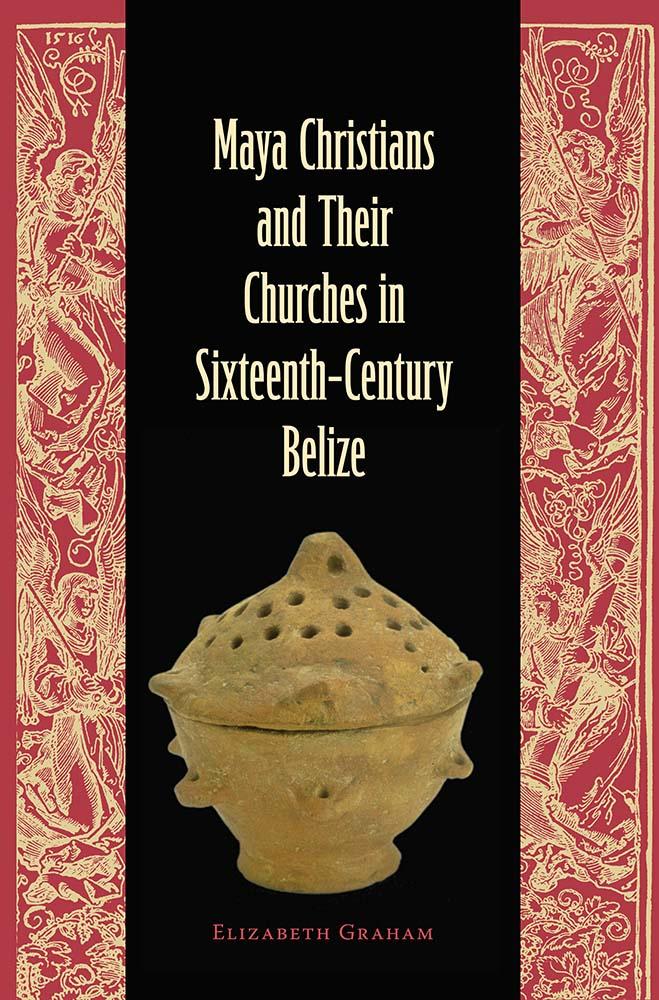
It is widely held that Christianity came to Belize as an extension of the conquest of Yucatan and that adherence to Christian belief and practice was abandoned in the absence of enduring Spanish authority. An alternative view comes from the excavations of Maya churches at Tipu and Lamanai, which show that the dead were buried in Christian churchyards long after the churches themselves fell into disuse, and pre-Columbian ritual objects were cached in Christian sacred spaces both during and after Spanish occupation. Excavations also reveal that the architectural style of these early churches is Franciscan in inspiration but nonetheless the product of continuing community efforts at construction and repair. A conclusion difficult to ignore is that the Maya of Tipu and Lamanai considered themselves Christians with or without Spanish presence.
Viewing historical and archaeological data through the lens of her personal experience of Roman Catholicism, and informed by feminist approaches, Elizabeth Graham assesses the concept of religion, the significance of doctrine, the empowerment of the individual, and the process of conversion by examining the meanings attributed to ideas, objects and images by the Maya, by Iberian Christians, and by archaeologists. Graham’s provocative study also makes the case that the impact of Christianity in Belize was a phenomenon that uniquely shaped the development of the modern nation.
A volume in the series Maya Studies, edited by Diane Z. Chase and Arlen F. Chase
Betala smidigt med kort, Klarna, Apple Pay eller Google Pay. Är du inte nöjd har du alltid 14 dagars ångerrätt. Läs mer i våra villkor. Har du några frågor, mejla oss på hello@memmo.org.
Memmo gör det enklare att plugga – var du än är i världen. Hos oss samlar du kursböcker och smarta studieverktyg på ett och samma ställe: sammanfattningar, quiz, poddar och flashcards. Och så Ted, din studiekompis som svarar på allt du undrar. Över 50 000 studenter pluggar redan här – byggt för att du ska lära dig snabbare och stressa mindre.