
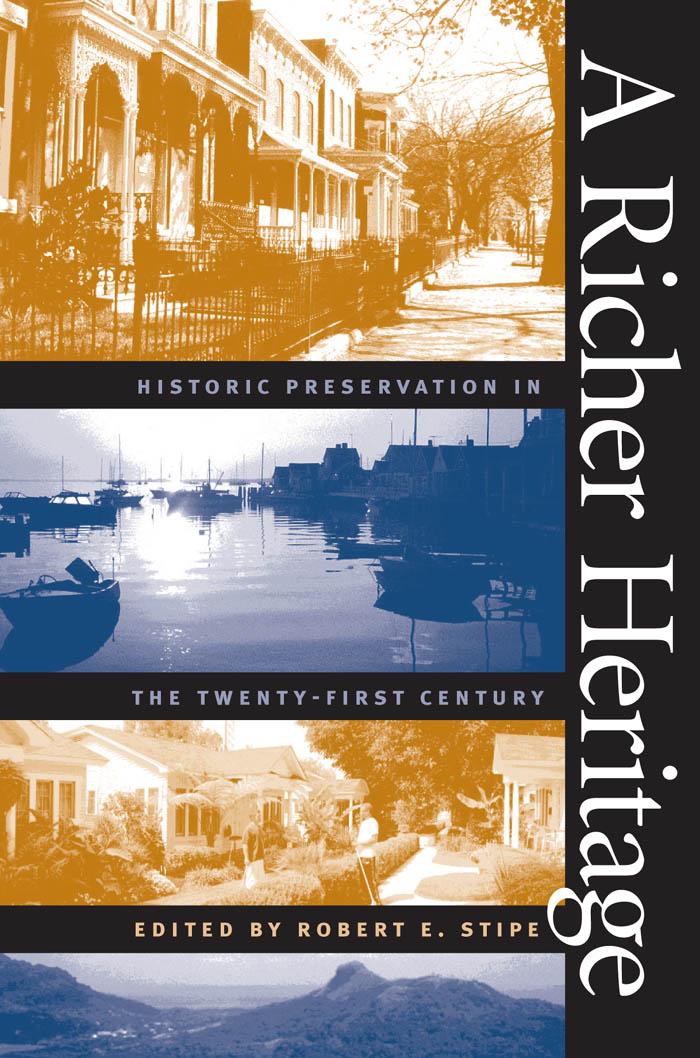
Surveying the past, present, and future of historic preservation in America, this book features fifteen essays by some of the most important voices in the field. A Richer Heritage will be an essential, thought-provoking guide for professionals as well as administrators, volunteers, and policy makers involved in preservation efforts.
An introduction traces the evolution of historic preservation in America, highlighting the principal ideas and events that have shaped and continue to shape the movement. The book also describes the workings — legal, administrative, and fiscal — of the layered federal, state, and local government partnership put in place by Congress in 1966. Individual chapters explore the preservation of designed and vernacular landscapes, the relationship between historic preservation and the larger environmental and land-trust movements, the role of new private and nonprofit players, racial and ethnic interests in historic preservation, and the preservation of our intangible cultural values. A concluding chapter analyzes the present state of the historic preservation movement and suggests future directions for the field in the twenty-first century.
Contributors include preservationists, local-government citizen activists, an architect, landscape architects, environmentalists, an archaeologist, a real-estate developer, historians, a Native American tribal leader, an ethnologist, and lawyers.
An introduction traces the evolution of historic preservation in America, highlighting the principal ideas and events that have shaped and continue to shape the movement. The book also describes the workings — legal, administrative, and fiscal — of the layered federal, state, and local government partnership put in place by Congress in 1966. Individual chapters explore the preservation of designed and vernacular landscapes, the relationship between historic preservation and the larger environmental and land-trust movements, the role of new private and nonprofit players, racial and ethnic interests in historic preservation, and the preservation of our intangible cultural values. A concluding chapter analyzes the present state of the historic preservation movement and suggests future directions for the field in the twenty-first century.
Contributors include preservationists, local-government citizen activists, an architect, landscape architects, environmentalists, an archaeologist, a real-estate developer, historians, a Native American tribal leader, an ethnologist, and lawyers.
Betala smidigt med kort, Klarna, Apple Pay eller Google Pay. Är du inte nöjd har du alltid 14 dagars ångerrätt. Läs mer i våra villkor. Har du några frågor, mejla oss på hello@memmo.org.
Memmo gör det enklare att plugga – var du än är i världen. Hos oss samlar du kursböcker och smarta studieverktyg på ett och samma ställe: sammanfattningar, quiz, poddar och flashcards. Och så Ted, din studiekompis som svarar på allt du undrar. Över 75 000 studenter pluggar redan här – byggt för att du ska lära dig snabbare och stressa mindre.
Du kanske också gillar
Köp boken0