
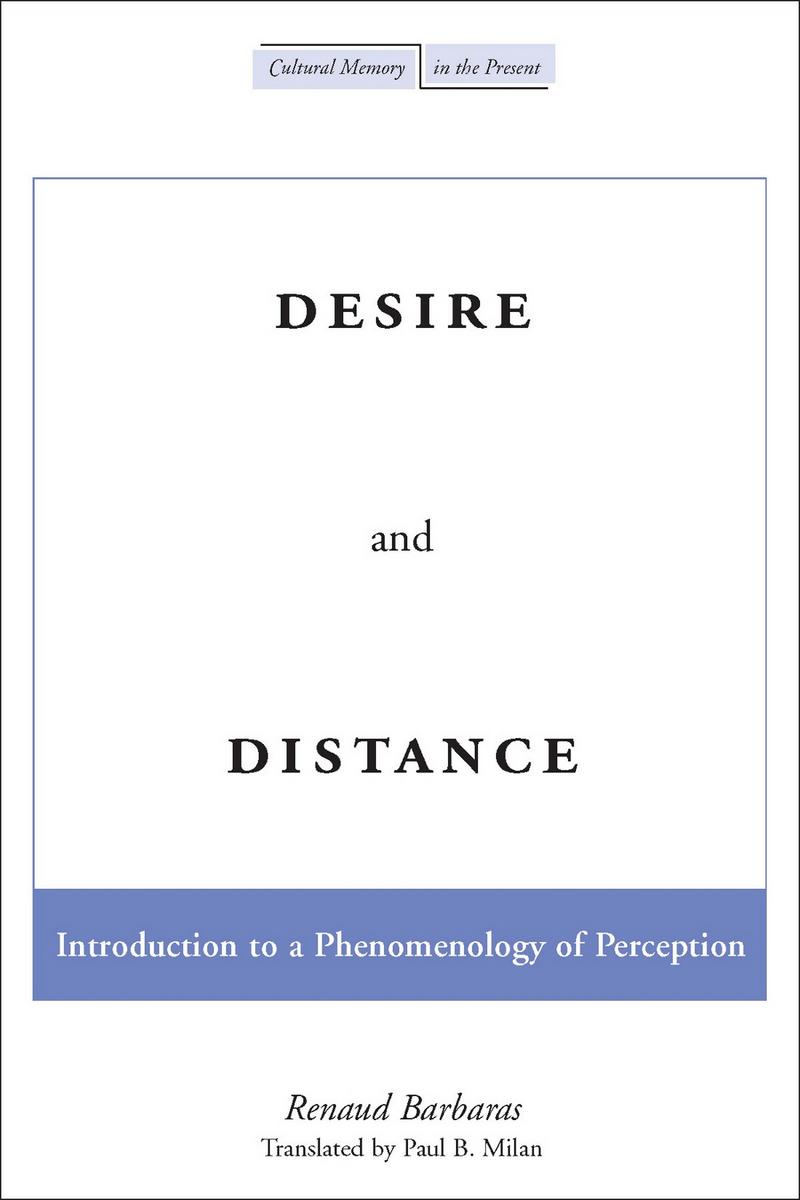
Desire and Distance constitutes an important new departure in contemporary phenomenological thought, a rethinking and critique of basic philosophical positions concerning the concept of perception presented by Husserl and Merleau-Ponty, though it departs in significant and original ways from their work. Barbaras's overall goal is to develop a philosophy of what "life" is—one that would do justice to the question of embodiment and its role in perception and the formation of the human subject. Barbaras posits that desire and distance inform the concept of "life." Levinas identified a similar structure in Descartes's notion of the infinite. For Barbaras, desire and distance are anchored not in meaning, but in a rethinking of the philosophy of biology and, in consequence, cosmology.
Barbaras elaborates and extends the formal structure of desire and distance by drawing on motifs as yet unexplored in the French phenomenological tradition, especially the notions of "life" and the "life-world," which are prominent in the later Husserl but also appear in non-phenomenological thinkers such as Bergson. Barbaras then filters these notions (especially "life") through Merleau-Ponty.
Betala smidigt med kort, Klarna, Apple Pay eller Google Pay. Är du inte nöjd har du alltid 14 dagars ångerrätt. Läs mer i våra villkor. Har du några frågor, mejla oss på hello@memmo.org.
Memmo gör det enklare att plugga – var du än är i världen. Hos oss samlar du kursböcker och smarta studieverktyg på ett och samma ställe: sammanfattningar, quiz, poddar och flashcards. Och så Ted, din studiekompis som svarar på allt du undrar. Över 50 000 studenter pluggar redan här – byggt för att du ska lära dig snabbare och stressa mindre.