
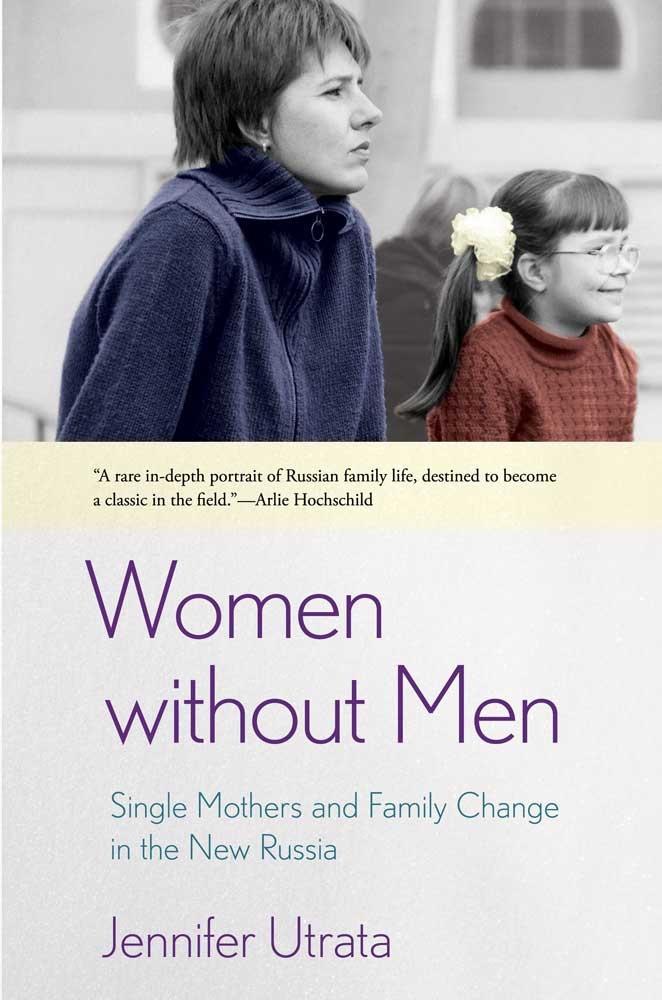
Women without Men illuminates Russia's "quiet revolution" in family life through the lens of single motherhood. Drawing on extensive ethnographic and interview data, Jennifer Utrata focuses on the puzzle of how single motherhood—frequently seen as a social problem in other contexts—became taken for granted in the New Russia. While most Russians, including single mothers, believe that two-parent families are preferable, many also contend that single motherhood is an inevitable by-product of two intractable problems: "weak men" (reflected, they argue, in the country's widespread, chronic male alcoholism) and a "weak state" (considered so because of Russia's unequal economy and poor social services). Among the daily struggles to get by and get ahead, single motherhood, Utrata finds, is seldom considered a tragedy.
Utrata begins by tracing the history of the cultural category of "single mother," from the state policies that created this category after World War II, through the demographic trends that contributed to rising rates of single motherhood, to the contemporary tension between the cultural ideal of the two-parent family and the de facto predominance of the matrifocal family. Providing a vivid narrative of the experiences not only of single mothers themselves but also of the grandmothers, other family members, and nonresident fathers who play roles in their lives, Women without Men maps the Russian family against the country's profound postwar social disruptions and dislocations.
Betala smidigt med kort, Klarna, Apple Pay eller Google Pay. Är du inte nöjd har du alltid 14 dagars ångerrätt. Läs mer i våra villkor. Har du några frågor, mejla oss på hello@memmo.org.
Memmo gör det enklare att plugga – var du än är i världen. Hos oss samlar du kursböcker och smarta studieverktyg på ett och samma ställe: sammanfattningar, quiz, poddar och flashcards. Och så Ted, din studiekompis som svarar på allt du undrar. Över 50 000 studenter pluggar redan här – byggt för att du ska lära dig snabbare och stressa mindre.