
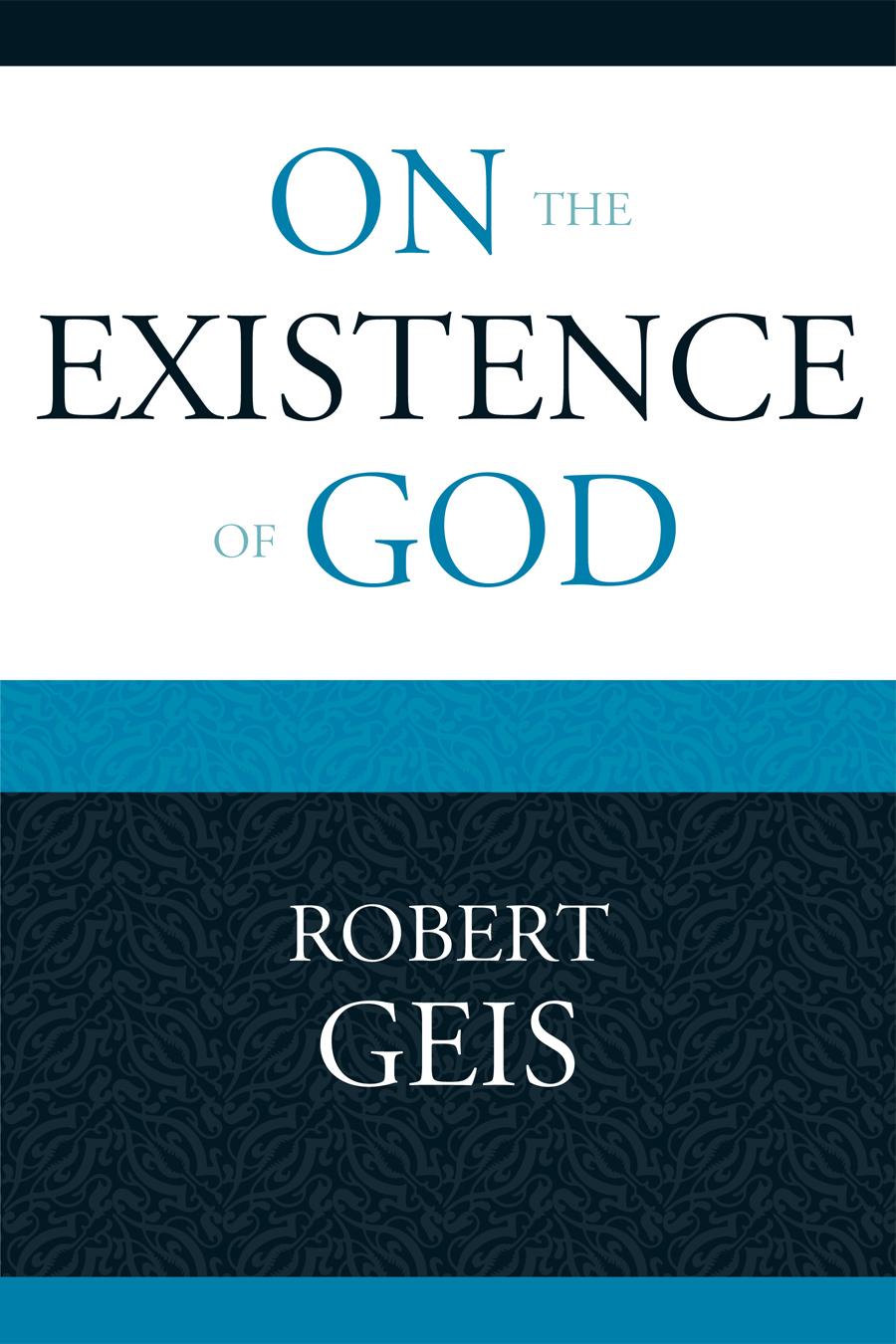
The existence of God raises many questions. Geis' work addresses queries that arise from the gratuitous claims of empiricism in Hume, unfounded assumptions in Kant, presumptions of science, and the improbabilities it identifies in Darwinism. By focusing on number and proportion as intrinsic to material and atomic constituency, any argument from chance as instrumental to the cosmos' emergence and sustainability becomes invalidated. The arguments from contingency and the nature of intellection provide more clarity than the ratio Anselmi for acknowledging a transcendent causality, taking the reader to the problem of evil and present-day nihilism. These concepts present great, but not insuperable, difficulty for theism. Geis argues that evil, when one uses it as a means to the betterment of oneself and the world, takes on the rôle commensurate with the doctrine of an omnibenevolent deity. Accordingly, one can use evil as a means to a greater understanding of God, Providence, and eternal destiny.
Betala smidigt med kort, Klarna, Apple Pay eller Google Pay. Är du inte nöjd har du alltid 14 dagars ångerrätt. Läs mer i våra villkor. Har du några frågor, mejla oss på hello@memmo.org.
Memmo gör det enklare att plugga – var du än är i världen. Hos oss samlar du kursböcker och smarta studieverktyg på ett och samma ställe: sammanfattningar, quiz, poddar och flashcards. Och så Ted, din studiekompis som svarar på allt du undrar. Över 50 000 studenter pluggar redan här – byggt för att du ska lära dig snabbare och stressa mindre.